Tuesday, May 17, 2016

Distortion Evidence: Bengalization of NKS Hindi

From: Renu Chakraborty <r.cborty@uni-tel...>
To: Ananda Marga Discourses <anandamargadiscourses@sunlink.net>
Subject: Distortion Evidence: Bengalization of NKS Hindi
Date: Tue, 17 May 2016 13::43:25 +0530

Bábá
Distortion Evidence: Bengalization of NKS Hindi

Namaskar,

In the discourse “Vraja Krśńa and Dvaetavada” (1), Bábá spoke the below yellow paragraph in Hindi. However in the Hindi edition of this discourse, our Tiljala Publishers did not print the Hindi “As-Is” words of Bábá; instead they printed concocted words.


Proof of Bengalization

The following yellow para is the As-Is transcription of Bábá NKS-17 (Nammi Krśńa Sundaram) in Hindi. But due to Bengalization, our Tiljala Publishers adulterated and distorted this para. If you search the NKS discourse #17 in any NKS Hindi book, in chapter #17 you will not find these yellow identical sentences. These original Bábá’s sentences are changed. The question is, why did our Tiljala Publishers not directly print what Bábá said in Hindi, in the Hindi edition.

With this Bengalization, everything is ruined. Please go and check your Hindi NKS book, discourse #17. You will not find these identical sentences. This is called Bengalization-- i.e. ruining the discourse.

“As-Is” transcription of Bábá’s audio: पानी चन्दन के पास पहुँच रहा है | तो, उसमें चन्दन की खूबियाँ आ रही हैँ—और वह पानी नहीं रहेगा | इसमें दो बातें हैं, एक चन्दन के पास पहुँचते ही क्या होता है ? चन्दन की खूबियाँ फ़ौरन आ जाती हैं | वे चाहें चाहे नहीं चाहें, चन्दन के प्रति अगर उनके दिल में मुहब्बत हो, तो, चन्दन का असर पड़ जाएगा | नज़दीकी का असर पड़ जाएगा, इसलिए वह खुद चन्दन बन जाएगा | और यहाँ दूसरी बात यह भी होती है, वह क्या है ? साधक चन्दन के पास, चन्दन के नज़दीक जितने पहुँचते रहेंगे, वे खुद को, स्वयं को शुद्ध बनाते रहेंगे | और, शुद्ध बनाते-बनाते जब वे चन्दन के पास पहुँच गए, तब देखेंगे क्या ? वे पानी नहीं हैँ | वे अपने को खो डालेंगे | वे अपने को चन्दन में खो डालेंगे |” (1)


Distorted Version Printed by Tiljala Publishers in NKS Hindi 1996 Edn

The below is a scan of the 1996 Hindi Edition of NKS, pages 125 and 126. The section highlighted in red is the place where the above yellow Hindi para—which Bábá Himself spoke—should have appeared. But in the below scan, it is not printed “as is” by our Tiljala Publishers.

This loss of Bábá’s original words due to BengalIzation represents distortion and veritable ruination of AM holy scripture.
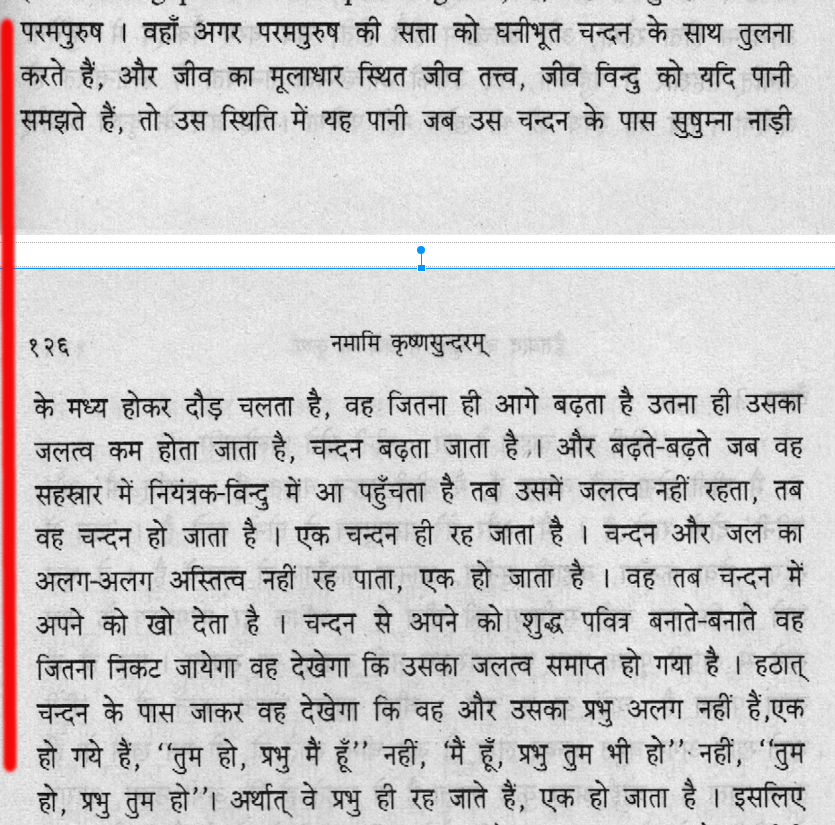
NKS17 scan w-red line.png
(2)

Again, the above is a scan of the 1996 Hindi Edition of NKS, pages 125 and 126. The section highlighted in red is the place where the yellow Hindi para (shown above)—which Bábá Himself spoke—should have appeared. But in the above scan, it is not printed “as is” by our Tiljala Publishers.

This loss of Bábá’s original words due to BengalIzation represents distortion and veritable ruination of AM holy scripture.

Namaskar,
Renu Chakraborty

Note: This discourse is in Bangla and Hindi. So those who understand Bangla and Hindi and want to dig deeper on this subject of Bábá’s discourse, they are welcome to contact us and we will provide them Bábá’s audio file of the discourse. Contact email: Ananda Marga Discourses <anandamargadiscourses@sunlink.net>

Note 2: Any who have difficulty seeing scan, click here to see it on our blog.

For Further Study

Scripture Must Be Universal,
Not Limited by Any Narrow Sentiment

Today our Ánanda Márga scripture is being encroached upon by narrow sentiments, and that will lead to its destruction. The scripture given by Shrii Shrii Ánandamúrti is dharma. It must be saved from limited sentiments at any cost.

Bábá says, "When the sole purpose of scripture, i.e. dharmashástra is to establish the human beings in the stable, exalted position of spiritual ideation, it must be practical, rational, infallible and universal. It must be based on deep eternal truths. It must be áptavákya. A scripture is a guided entity." (3)

Again, the purpose of this letter is to make Bábá's printed discourses authentic and dogma-free. This is not a language issue this is an issue of authenticity. The duty of every disciple of Lord Shrii Shrii Ánandamúrtiji is to keep an eye on the purity of Guru's printed books. Indeed, we Ánanda Márgiis must express our voice and save our scripture.

References.
1. The yellow highlighted para is the “As-Is” transcription of “Vraja Krśńa and Dvaetavada”, 14 December 1980, Calcutta.
2. The above scan is from “Vraja Krśńa and Dvaetavada”, Namami Krśńa Sundaram, Chapter 17, 14 December 1980, Calcutta.

3. “Our Spiritual Treatise “ Tattva Kaomudii - 2, 24 February 1970, Ranchi

Wednesday, May 4, 2016

Distortion in NKS Book

From: Shefali Dutta <sf.dutta@bengalcom....>
To: Ananda Marga Discourses <anandamargadiscourses@sunlink.net>
Subject: Distortion in NKS Book In H&B Editions
Date: Wed, 4 May 2016 11:27:53 +0530


BABA


Distortion in NKS Book In H&B Editions


Namaskar,


Baba’s “Namami Krsna Sundaram” (NKS) book discourse #6 (see note 1) has a blunder, which is described below.


Proof of Distortion


Please see carefully the yellow segment below, which is in Bengali. That is what Baba spoke. But it is missing in the Bangla NKS book. And also in the Hindi NKS book.
The below typed para is the As-Is version. And its yellow segment should be situated on the scan, at the location of the red “X” mark-- but it is not. Fortunately, the unhighlighted section in the below para, is present in the book. But the yellow section is missing.


Excerpt from Baba’s Audio transcription-- [audio 4:57] “তখনও দ্রাবিড় ব্রাহ্মণ সমাজ আইয়ার ও আয়েঙ্গার, দুই শাখায় বিভক্ত হয়নি | আয়েঙ্গার মানে “বৈষ্ণব,” আইয়ার মানে “শৈব" | এই চিহ্নের [Horizontal or vertical sandalwood marks on the forehead] দ্বারা মানুষ ৰুঝতে পারৰে | [Baba, gesturing three vertical sandalwood marks] আয়েঙ্গার, বৈষ্ণব | [Baba, gesturing horizontal marks] আইয়ার | সে সময়, এই যে তন্ত্রের বিভাজনগুলো ছিল, কিন্তু এই বিভাজনগুলো সম্যক্‌ রূপ নেয়নি |” [audio 5:35] (see note 2)


Tiljala Publishers Left Section Out of Discourse


As mentioned, the section highlighted in yellow above is missing from the Bengali and Hindi language editions published by our Tiljala Publishers. In the passage, Baba describes how the Aiyars and the Ayengars--two main branches of Dravidian Brahmins-- could be easily distinguished from the distinct style in which each branch decorated their foreheads. Aiyars make horizontal lines on their foreheads, and Ayengars make vertical marks on the foreheads.


Here below is a scan of the Tiljala Publishers’ NKS book discourse #6 page 32 Hindi edn. (see note 3) There is a red ‘X’ marking the place where the missing passage should have been printed.


As mentioned, here above is a scan of the Tiljala Publishers’ NKS book discourse #6 page 32 Hindi edn. (see note 3) There is a red ‘X’ marking the place where the missing passage should have been printed.


It is critically important that everything Baba says in a discourse be printed. Otherwise, if our Tiljala Publishers remove sections of what Baba said, then the printed discourse is not an accurate record. Incomplete records may present a distorted picture of the message Taraka Brahma Baba intends to teach the human beings for all time to come.


If the subject matter present here is unclear, please write us.


Namaskar,
Shefali Dutta


Note: This discourse is in Bangla. So those who understand Bangla and want to dig deeper on this subject of Baba’s discourse, they are welcome to contact us and we will provide them Baba’s audio file of the discourse.
Contact email: Ananda Marga Discourses <anandamargadiscourses@sunlink.net>


Note
(1) Baba’s “Namami Krsna Sundaram” (NKS) book discourse #6 on 28 September 1980 in Calcutta.
(2) নমামি কৃষ্ণসুন্দরম্‌, প্রবচন ৬, “পার্থসারথি কৃষ্ণের জ্ঞানানুশীলন”, সংস্করণ ২০১২  
(3) नमामि कृष्णसुन्दरम्‌, प्रवचन ६, “पार्थसारथि कृष्ण का ज्ञानानुशीलन”, संस्करण १९९६
(4) In this letter we are referring to only two editions-- Bangla and Hindi; not any other editions. The central idea is that the Bangla and Hindi editions are faulty. And the Bangla book is treated as the original version, so in the future this distortion will reach everywhere.


For Deeper Understanding:


Discourse Must Be Printed As-Is


Baba says that apta vakya does not undergo metamorphosis or distortion. So if it does get changed or distorted, then it is no longer apta vakya i.e. the word of Guru. It is up to Ananda Margiis to protect our scripture and keep it "As Is"-- the word of Guru.


Will Cause Bloodshed and More Division


History bears testimony to this, that all the religions have similarly broken into multiple factions, groups and subgroups on the basis of differences in scripture interpretations. Bábá wanted to eliminate such problems, and that is why Bábá's discourses are recorded. But unfortunately, those recordings are not being published properly. This matter is very serious.
If we remain passive onlookers and do not fix the negative trends of introducing distortion into Shrii Shrii Ánandamúrtiji's discourses and do not bring the printed discourses up to the proper standard now, it will become impossible to change this in the future. And even if in future some sincere Ánanda Márgiis will try, they will be treated as enemies. Because this is the way religion works.


Today one cannot teach the devotees of Lord Krśńa that He has nothing to do with cows; they will never believe it. In the same way, Ánanda Márgiis will become used to the wrong teachings in our AM books and they will not like to give them up. They will think that whatever was there at the end of the twentieth century, that was the gold standard for all time. And it should be kept and maintained. So we don't have any time: it is either now or never. The clock is ticking: If we do not get Bábá's discourses fixed now, it will be impossible to do so later. And that will cause bloodshed and more division on the basis of the various versions of Bábá's teachings and their explanations.


Future Topics


Vraja Krsna and Vishistadvaetavada, NKS-15 MGD 30 November 1980 Calcutta


In this discourse, our Tiljala Publishers printed the second line of the below shloka, when Baba only spoke the first line.


অসূর্যা নাম তে লোকা অন্ধেন পরিবৃত্ততাঃ |

[তাঁস্তে প্রেত্যাভিগচ্ছন্তি যে কে চাত্মহনো জনাঃ ||] [Baba did not say this second line, but our Tiljala Publishers printed it.]

Thursday, April 21, 2016

Discourse Ravaged: Listen Sound File & Review For Yourself

From: Rekha Basu <rbasu@wbnet…>
To: Ananda Marga Discourses <anandamargadiscourses@sunlink.net>
Subject: Discourse Ravaged: Listen Sound File & Review For Yourself
Date: Thu, 21 Apr 2016 09:36:28

BABA

Discourse Ravaged:
Listen Sound File & Review For Yourself
Namaskar,
Thank you for your interest in this important topic that deals with the purity of Baba's printed books.
This letter addresses a point from chapter 18 of Ánanda Vacanámrtam Part 9-10 (see note 1).

Everyone is aware that Baba delivered this discourse in English (see note 3) but for Bengalization purposes the Tiljala Publishers (TP) translated the original English into Bengali and then back into English – thereby changing countless words and distorting the overall meaning. Please compare Tiljala's printed version with Baba's original sound file. (You may download Baba’s original sound file at the below link - see note 2).

This letter also gives proof how the English discourse was ravaged because Baba's original English discourse was not transcribed, but rather translated and retranslated from English to Bengali to English, for purposes of Bengalization. That is why the philosophical meaning has also been changed. This is not an ordinary mistake but a blunder.

One other fundamental error they made in publishing this discourse is how they changed mental color to physical color - and many more mistakes.
Read the below and it will be crystal-clear. Also be sure to play the sound and carefully review the published discourse. In the below letter everything is explained.

If you are new to this network and you tried but are still not sure how to proceed then let us know. We will help you.
The purpose of this letter is to make Baba's printed discourses authentic and dogma-free. This is not a language issue this is an issue of authenticity. The duty of every disciple of Lord Shrii Shrii Anandamurtiji to keep eye on the purity of Guru's printed books.


Tiljala Publishers Deleted Sadguru & Disciple Dialogue

Throughout this discourse Bábá is talking about mental color. Yet this below key passage was completely omitted and permanently removed from the printed discourse. However, these are the very words which Sadguru Baba spoke. You can listen for yourself at the 4min 53sec mark of the audio file that is uploaded to the blog.

Baba Audio (4:53): Listen to the sound file and see for yourself.
[Baba Speaks] [Time on audio file 4:53]  Now, what is varńa? Varńa is external manifestation of the, what?
[Márgiis are silent.]
[Baba Speaks] What?
[Márgiis still remain silent.]
[Baba Speaks] Of the inner self.

This interchange between Bábá and the márgiis has itself been removed from the printed discourse . The live interactions between Bábá and the márgiis hold tremendous value and importance. They lend context, feeling, and meaning to the discourse and it is not proper to remove these from the printed discourse. Rather they add a special dimension.

But the publishers removed – or never included - this section, yet these are the very words Baba spoke. And Baba's whole point is that color refers to mental color. But Tiljala failed to include this in the published discourse. And then later they wrote as if Baba is talking about physical color. This mistake they made throughout the discourse.

Namaskar,
Rekha Basu


Note 1: Full Name of Discourse
The Supreme Entity Transcends all Colours” is chapter 18 of Ánanda Vacanámrtam Part 9-10

Note 2: Listen to Baba's Original Audio File
& Compare with Printed Discourse
(To listen only, click on icon at upper right corner of blog)


Note 3: Bábá Spoke Mainly In English

Here is the breakdown of the amount of time Bábá spent in this discourse speaking English and Bengali. The total discourse length is 10:47 minutes; of that, Bábá spoke in English for 7:15 minutes, and in Bengali for 3:32 minutes. That means Bábá spoke in English 68% of the time, and in Bengali merely 32% of the time. In such a case, how could the Tiljala Publishers write in their Publishers Note that the discourse was given only in Bengali? This statement is a flat-out lie. And they have no excuse to justify this lie: they have the sound recording, and after listening to it and knowing the contents of this mainly English discourse, they have reported—Discourse in Bengali”.

In brief, here is the breakdown of time Bábá spent speaking each language:

English = 7:15 min total = 68% of discourse

Bengali = 3:32 min total = 32% of discourse

             10:47 total time


For more information, please visit our Ananda Marga Discourses home page

Download Sound File Baba Discourse "The Supreme Entity Transcends All Colours"

English Discourse Labeled As Bangla—Narrow Sentiment

The discourse "The Supreme Entity Transcends All Colours" was given by Baba in Calcutta, 11 April 1979. The main language of this discourse is English. This is what Tiljala group should have written in the Publishers Note—that the discourse was given by Bábá in English. But instead they labeled the discourse as having been given in Bengali.

Here below as proof is the download link for this Baba discouse, given mainly in English:

Click here to download the sound file.

Scans: The Supreme Entity Transcends All Colours

Baba

Here are the scans of the discourse - The Supreme Entity Transcends All Colours - from the book Ananda Vacanamrtam 9-10, (2007), chapter 18, pages 113 - 116.


1) Click here to download the sound file of the discourse


(2) To simply listen to the Sound File of Discourse, without downloading:

 Click on icon in right column, upper right corner of this page


(3) Click here to see where they claim in the Publisher's Note that the discourse was translated from the original Bengali.


(4) Click here to read the posting about the errors in the published version of the English edition of this discourse.


Thursday, April 14, 2016

Bengalization of NKS (English)

From: Pratima Bhattacharya <pbhattacharya@tcom...>
To: Ananda Marga Discourses <anandamargadiscourses@sunlink.net>
Subject: Bengalization of NKS (English)
Date: Thu, 14 Apr 2016 11:27:48 +0530


BABA

Bengalization of NKS (English)

Namaskar,

On 14 December 1980 in Calcutta, Baba has given a discourse in which He spoke one section in English. For the English language publication, that section Baba had given originally in English was not used; rather the English sentences were translated in Bengali, then from Bengali were re-translated into English and printed in the English book. Thus Baba’s original English words were lost.

#1 Baba’s Original English Words

Here is what Baba actually said in the discourse, in English.

Baba’s voice, As-Is:
“‘One plus one is equal to two’, first phase. ‘One plus one is equal to one’, second stage. And, ‘one plus one, what is that thing ? I do not know’---is the final stage.”

But due to double translation, it became as follows:
“1 + 1 = 2. This is the first stage. 1 + 1 = 1. This is the second stage. 1 + 1 = “What? I do not know.” This is the final stage.”

This above altered section is printed in the English NKS book.

This whole episode of ruining an English discourse in the above described fashion, is called Bengalization.

Namaska’r,
Pratima Bhattacharya


Note: NKS = Namami Krsna Sundaram

The above passage is from Vraja Krsna and Dvaetavada, NKS chapter 17, MGD 14 December 1980 Calcutta

Detail Study-- If the matter is not fully clear, please go on reading below:

#2 How did this happen?

Our Tiljala Publishers’ Bengali Translation

In the Bengali Publication of the discourse, this section originally spoken by Baba in English, was translated by the Tiljala Publishers into Bengali. Here is how it got printed in the Bangla NKS book:

“এই + এক = দুই, এটা হ’ল প্রথম অবস্থা | এক + এক = এক, এটা দ্বিতীয় অবস্থা | এক + এক = এ কী ? না, আমি জানি না; এইটা হ’ল শেষ অবস্থা |”

Then, when our Tiljala Publishers translated the discourse into English for the English language publication, instead of using Baba’s original English, our Tiljala Publishers instead re-translated what they’d themselves written in Bengali, into English. Here below is how it is printed in the Electronic English Edition by our Tiljala Publishers:


#3 Our Tiljala Publishers’ English Re-Translation

“1 + 1 = 2. This is the first stage. 1 + 1 = 1. This is the second stage. 1 + 1 = “What? I do not know.” This is the final stage.”

Take note that the English version published by our Tiljala Publishers (#3), does not look at all like the original English version spoken by Baba (#1). That is because Baba’s original English words were translated into Bengali, then that very translated discourse got re-translated from Bangla back into English by our Tiljala Publishers. And by so doing, Baba’s original words were lost.

This sort of double-translation or re-translation, is unnecessary and represents a kind of distortion. Many times in so doing, the spirit and meaning is changed. The question is, what was the need to do this? For an English book, it would have been better if our Tiljala Publishers had directly given what Baba said---as He said it in English.

Note 1. Some people may say these are not serious mistakes. The answer to this is: It depends on one’s perspective. Just like, one dust particle although it is small, but if it gets inside one’s eye then one will not dismiss it as small. So in this letter, the point which is raised is very important, that Baba’s discourses should be given to Margii readers without alteration. When Baba speaks in English, then there is no need to pollute it by Bengalization i.e. translating into Bangla and then translating that Bangla version back into English and providing to English readers. So here the main point is that Bengalization of Baba’s discourses must stop.

Note 2. Those who do not have this NKS chapter 17, and would like to read it, please inform us at Ananda Marga Discourses <anandamargadiscourses@sunlink.net>, and we will provide you the published English discourse.

Note 3. There are several more important points in connection with this Baba’s quote, which I will bring in a subsequent posting.

Thursday, December 3, 2015

Ekendriya Chapter English Version Ruined

From: Gopal Roy Choudhary <grchoudhary@bengalcom...>
To: Ananda Marga Discourses <anandamargadiscourses@sunlink.net>
Subject: Ekendriya Chapter English Version Ruined
Date: Thu, 3 Dec 2015 13:42:05 +0530


Bábá


Ekendriya Chapter English Version Ruined 

Respected M
árgii Brothers and Sisters,
Namask
ár,

The discourse Ekendriya-3 has been given by Bábá in Bengali, in Calcutta.(1) Reviewing the As-Is transcription of Bábá’s original Bengali discourse as well as the published English translation, I have found that the English version contains serious distortion in comparison to Bábá’s original Bengali.

Bábá Points out Advaetavádiis - ​followers of non-dualistic philosophy

In the concerned section of the discourse, Bábá explains in detail that those involved with advaetaváda commit themselves to the wrong idea that the world is false and defend this idea with endless debate and discussion about advaetaváda. That is all those advaetavádiis do; they don’t do sádhaná, don’t ideate on Parama Puruśa. They give importance to study of their advaetaváda scripture, and that is all.  So here Bábá is pointing out these máyávádiis, that they ruined their lives by not doing sádhaná, not ideating on Parama Puruśa, and just remaining busy in debates of non-dualistic philosophy. In this way they ruined their lives—this is the jist of what Bábá is conveying in this section of the discourse.


Our Tiljala Publishers Confused Advaetavádiis - ​followers of non-dualistic philosophy - for Communists

But because of poor translation, in the English published version this section got fatally distorted. And due to the section’s central importance in the discourse meaning, the overall message of the discourse itself has been ruined.

In their translation, our Tiljala Publishers depicted Bábá as attacking communists rather than advaetavádiis, by indicating that members of the group “deny the existence of Parama Puruśa”.

In this discourse Ekendriya-3, our Tiljala Group Dadas have published the following serious distortion: “The life of a person obsessed with philosophical theory, who denies the existence of Parama Puruśa, is bound to become wrought with frustrations.” 


But Bábá is talking about advaetavádii pańďitas, not about communists. Advaetavádiis do not at all deny the existence of Parama Puruśa.

This is a fundamental philosophical blunder.


English Version of Discourse Ruined by Our Tiljala Publishers

Due to the mistake in the above yellow highlighted section, the translation has been ruined. In the original discourse Bábá says in Bengali, “Those who do not do meditation on Parama Puruśa, but instead spend all their time feverishly involved in philosophical debate”. Whereas in the English translation it is ruined, by referring to this idea as “those who do not believe in Parama Puruśa”. In the yellow highlighted section, the words are not matching between the original Bengali and the translated English. The English translation is taking the subject in a different direction, pointing out communists when Bábá is talking instead about advaetavádiis, who believe in Parama Puruśa but instead of doing meditation, merely waste their lives arguing over scriptures.
Namaskár,
Gopal Roy Choudhary


Note: See Below For Detailed Comparison

For in-depth study, here below two larger excerpts are given from (1) the As-Is transcription of Bábá’s original Bengali discourse and (2) the corresponding published English. Please pay attention to the yellow highlighted part of both. Within that highlighted section, the underlined words are the “eye of the storm” as they stray markedly from Bábá’s Bengali original.

Those who read superficially, may not understand the seriousness of this blunder. But if one reads carefully, then one will understand that due to this mistake, the entire section went away from máyávádiis, to communists. That was not the intention of Bábá. So, the conclusion is that Bábá’s original Bengali discourse and our Tiljala Group dadas’ published English translation, are moving in two markedly different directions.

(1) As-Is Transcription of the original Bengali, Ekendriya – 3, 3 May 1981 Calcutta, exactly as 
Bábá stated it:

তোমরা দেখো, বিশুদ্ধ-অদ্বৈতবাদ নিয়ে খুৰ মাতামাতি হয়েছিল, দীর্ঘ দিন ধরে ভারতে | এটা সৰাই স্বীকার করৰে যে সেই বিশুদ্ধ-অদ্বৈতবাদ আজ ধরাশায়ী | হ্যাঁ | কিন্তু যারা সেই বিশুদ্ধ-অদ্বৈতবাদকে জীবনের সার মেনেছিল, তার মনের পুঞ্জীভূত শক্তিকে এই বিশুদ্ধ-অদ্বৈতবাদের রেখায়, লেখায়, শাখায়, উপশাখায় ন্যস্ত করেছিল, বিন্যস্ত করেছিল, তারা যখন দেখৰে যে যে গাছের শাখা উপশাখায় আমি পল্লবিত হয়েছিলাম, সে গাছের গুঁড়িটাই নেই, তখন তার কি অবস্থা হৰে ? সে জানতে মারা হয়ে যাৰে | তার সমস্ত আশা-আকাঙ্ক্ষা চূর্ণীকৃত হয়ে যাৰে | সৰ শেষ হয়ে যাৰে | পরমপুরুষের কথা না ভেবে, যে দার্শনিক তত্ত্ব নিয়ে মাতামাতি করে এসেছিল, তার জীবন একটা হতাশার ৰিন্দুতে পর্য়বসিত হৰে | 

(2) From the Electronic Edition, Ekendriya – 3, 
3 May 1981 Calcutta,  Ananda Marga Philosophy in a Nutshell Part 6

“You know in the past in India there was a debate on the theory of pure non-dualism (vishuddha advaetaváda) which continued for a long time. Today this theory has been almost totally rejected. Those who accepted it as their cherished philosophy, investing all their accumulated mental energy on its different branches and ramifications, met a tragic end. They discovered that the trunk of the tree, in whose branches, twigs and foliage they had been taking shelter, had been felled! They joined the ranks of the living dead, their hopes and aspirations shattered forever.The life of a person obsessed with philosophical theory, who denies the existence of Parama Puruśa, is bound to become wrought with frustrations.”

Footnotes

1. Ekendriya – 3.  3 May 1981 Calcutta.