Friday, September 9, 2016

Discourse distortion AV-3: North Pole changed to Nagpur

BABA

Discourse distortion AV-3: North Pole changed to Nagpur


Namaskár,

Bábá says in the "As Is" discourse--- "In North Pole You may ask, 'Mahámáyá, oh Mahámáyá, I want a mango,’---then and there, it will be present there."

Our Tiljala Publishers (TP) have printed---"In Nagpur You may say, ‘Oh, Mahámáyá, I want a mango,’ and then and there it will be furnished."

Conclusion: TP changed “North Pole” to “Nagpur”.

*********
If the point raised is unclear, please go on reading.


Distortion AV-3: Detailed version is below

Bábá has given the discourse “Prańáma Mantra” in Patna on 5 October 1978, in Patna. Our Tiljala Publishers have printed that discourse in Ananda Vacanamrtam part 3, where it is discourse #5. And there in one section, our Tiljala Publishers have printed the following line--

Our Tiljala Publishers (TP) have printed---"In Nagpur You may say, ‘Oh, Mahámáyá, I want a mango,’ and then and there it will be furnished."

Comment: Here, the word 'Nagpur' is concocted by our Tiljala Publishers. And this imaginary word “Nagpur” is undermining the uniqueness of Mahámáyá (all-pervading Maya). Because in Nagpur, the common man can effortlessly get Mangos. So if Mahámáyá furnishes a mango in Nagpur, that is not a big thing. That is why Bábá did not give the term ‘Nagpur’; it is obviously fictitious.

The actual words Bábá has spoken at this point in the discourse, are the following--

Bábá says in the "As Is" discourse-, "In North Pole You may ask, 'Mahámáyá, oh Mahámáyá, I want a mango,’---then and there, it will be present there."

Comment: Bábá is describing a situation in which, in the North Pole, Mahámáyá is requested to furnish a mango. It is not a joke for common people to produce a mango immediately in the North Pole. But Mahámáyá with Her all-powerful nature, then and there furnishes a mango at the request of Parama Purusa.

Here in place of Bábá's actual word 'North Pole', our Tiljala Publishers have printed 'Nagpur'. So if Mahámáyá furnishes a mango in Nagpur, that is not a big thing. This imaginary word “Nagpur” is undermining the uniqueness of Mahámáyá (all-pervading Maya). On this very point, our Tiljala Publishers' version is not only not what Bábá said, but it is nonsensical. Here the main damaging distortion, is 'Nagpur' in place of 'North Pole'.

In summary: By printing ‘Nagpur’ in place of ‘North Pole’ the entire subject becomes ludicrous and meaningless. This underscores how critically important it is that Bábá's published discourses be "As Is". They must contain the precise words Bábá Himself has said, and should not contain these sorts of misleading distortions introduced by our publishers.

Bábá says in the "As Is" discourse--- "In North Pole You may ask, 'Mahámáyá, oh Mahámáyá, I want a mango,’---then and there, it will be present there."

Conclusion: TP changed North Pole to Nagpur

The mistake is obvious.

Namaskar,
In service to Gurudeva,
Krishna Ganguli


And there are many other words as well in this discourse which by comparing with the “As-Is” discourse, you will find changed in the TP printed version.

Note 1.

Fix Bábá's Discourses Now or Never

If we remain passive onlookers and do not fix the negative trends of introducing distortion into Shrii Shrii Ánandamúrtiji's discourses—if we do not bring the printed discourses up to the proper standard now—it will become impossible to change this in the future. And even if in future some sincere Ánanda Márgiis will try, they will be treated as enemies. Because this is the way religion works: Today one cannot teach the devotees of Lord Krśńa that He has nothing to do with cows; they will never believe it. In the same way, Ánanda Márgiis will become used to the wrong teachings in our AM books and they will not like to give them up. They will think that whatever was there at the end of the twentieth century, that was the gold standard for all time. And it should be kept and maintained.

Ánanda Má́rga is dharma—not religion—but we will face the same opposition from within to change, when wrong teachings get established.

So we don't have any time: it is either now or never. The clock is ticking: If we do not get Bábá's discourses fixed now, it will be impossible to do so later. And that will cause bloodshed and more division on the basis of the various versions of Bábá's teachings and their explanations. History bears testimony to this, that all the religions have similarly broken into multiple factions, groups and subgroups on the basis of differences in scripture interpretations. Although Ánanda Má́rga is dharma—not religion.

Bábá wanted to eliminate such problems, and that is why Bábá's discourses are recorded. But unfortunately, those recordings are not being published properly. This matter is very serious.


Larger Section of material which is printed by TP in AV-3, Ch-5.

Our Tiljala Publishers (TP) have printed---
“O Lord, Thou art the creator of this universe. This universe is full of gems and jewels. So do You require anything from a poor man like me? Nothing. All the gems and jewels, everything, all the wealth of the world, belongs to You. And Your grhińii, Your spouse, is Mahámáyá. She is Your spouse, and according to Your order and desire She will supply You with anything. In Nagpur You may say, ‘Oh, Mahámáyá, I want a mango,’ and then and there it will be furnished. Mahámáyá is Your spouse, so there cannot be any want, there cannot be any shortage in Your store. So what shall I offer to Thee? I have heard that Your big devotees, by their strong devotion and love for You, have snatched away Your Mind, have taken away Your Mind. I am not a big devotee. The big devotees have taken away Your Mind. You have lost Your Mind. So there is a shortage of one thing, a shortage of mind. But Lord, You needn’t be disappointed. I have a mind with me – take that mind. I offer it to Thee.”

== Links ==

Recent postings


Note: In order to make Bábá’s books pristine, please forward this posting to the respected Tiljala Publications Secretary, dada Mantreshwarananda ji <Mantreshwarananda@hotmail.com>, and to respected dada Acyutananda ji, <acyutananda1@gmail.com>.

References
1. As-Is Bábá’s Discourse, “Prańáma Mantra”, Ananda Vacanamrtam part 3 discourse #5. 5 October 1978 Patna.

2. Tiljala-printed Publication,  “Prańáma Mantra”, Ananda Vacanamrtam part 3 discourse #5. 5 October 1978 Patna.

Monday, September 5, 2016

Bengalization: Blunder In SS-11


Date: Mon 5 Sep 2016 10:12:49 -0000 (GMT)
From: Biresh Mitra <m_mitra@link-net...>
Subject: Bengalization: Blunder In SS-11
To: Ananda Marga Discourses <anandamargadiscourses@sunlink.net>

BABA

Bengalization: Blunder In SS-11


Namaskar,

In the DMC discourse “The Supreme Desideratum of the Microcosms,” given in Hindi on 26 November 1978 in Bombay, our Tiljala Publishers made a serious mistake in the translation for the English edition. For the details of that mistake see below.

In His ‘As Is’ discourse, SS-11, Bábá says--

"संहार करनेवाले भी तुम्हारे पिता, और रक्षा करनेवाले भी पिता, तो बच्चे डरेंगे क्यों ? बाघ से और लोग डर सकते हैं, बाघ के बच्चे डरते नहीं हैं |"

The sense of the above Hindi is that----
"Your father Parama Purusa is the Destroyer as well as the Savior, so as His child, why should you be afraid of Him? Similarly the public may be afraid of a tiger, but the tiger's own cubs are not afraid of him."

See below the corresponding passage from the very same discourse, as published by our Tiljala Publishers in the Electronic Edition 7.5. It is from “The Supreme Desideratum of the Microcosms”, 26 November 1978 DMC, Bombay, printed in Subhasita Samgraha part 11--

"Just as the Destroyer is your Father, the Preserver is also your Father and why should the offspring be afraid of their Father? A father may be feared by others, but why should the sons and daughters be afraid of their father?"

Our Tiljala Publishers translated the original Hindi discourse into Bengali and from that Bengali, they translated into English. And in this lengthy process of double translation, Bábá's teaching about the tiger was completely lost. This is call Bengalization.

Conclusion

Bábá says in His original discourse-- “The public may be afraid of a tiger, but the tiger's own cubs are not afraid of him."

The Tiljala Publishers printed-- “A father may be feared by others, but why should the sons and daughters be afraid of their father?"

So the flaw is very obvious.

Namaskar,
In service to Gurudeva,
Biresh Mitra


Spiritual injunctions must be totally flawless

Verily, to change words in the publication of a discourse, alters the meaning and misguides readers. Táraka Brahma has given pristine, clear teachings. Mis-transcription and double translation opens the door to misinterpretation and dogma.

Bábá says,

"In the spiritual world, there should not be anything which will divert human beings from the path of synthesis to that of analysis, which will provoke divisive tendencies and restrict collective existence within narrow confines.”

“Nothing should ensnare people in the illusory net of pettiness in any sphere of life, from the general code of spiritual conduct to the universal and eternal principles of life – lest the voracious fangs of the all-consuming Máyá devour them. Thus the scriptures containing spiritual injunctions must be totally flawless.” (NSS, Disc: Shiva's Teachings – 2 (continued) (Discourse 14)

Sunday, September 4, 2016

Saḿskrta Must Be Revived--Baba


Subject: Saḿskrta Must Be Revived--Baba
Date: Sat, 3 Sep 2016 11:55:42 +0530
From: tr sukul <trsukulsagar@...>

BABA

Saḿskrta Must Be Revived--Baba

Many eminent scholars claim that Saḿskrta is the mother of most of the languages of the world. If we contemplate Rev. Baba's discourses, we find that the human civilization started about 15,000 years ago with the Rk Veda. The Rgvedic period continued up to 10,000 years ago and then originated the Yajurvedic age. During those days one almost identical language was current all the way from Central Asia and Eastern Europe to Southeast Asia. The branch of that language that was popular in Southeast Asia was called Saḿskrta, while the language spoken in the northeastern parts was Vedic. (1)

This simply indicates that Saḿskrta/Sanskrit is an ancient language and that other languages originated from it and varied according to the time, space and environment. Many scholars claim that the important words of Saḿskrta have been found common in different languages (especially Indo- European) of the world, hence they opine to say that Saḿskrta is the mother of most other languages. In this computer age many scholars have found that the algorithm and programming is comparatively easy using Saḿskrta grammar rules.

Strong will power needed to make Saḿskrta a live language

In this perspective, is it not our duty to place our grandmother Saḿskrta at her proper seat? We have neglected this fact and made Saḿskrta as a dead language. Rev. Baba has given an example in Varna Vicitra Vol 3 of how Hebrew was a dead language that was revived with the resettling of Jews in Israel. Baba continues to state how the same is the case with Saḿskrta and how Saḿskrta should be revived and made into a living language. Old Arabian and Hebrew are sister languages. Centuries ago Hebrew was eradicated from the soil of Israel and became as dead as old Arabian. With the rebirth of the new Israel, it was the will power of the country that they could revive Hebrew and restore it to its proper position declaring it the state and official language.  

Baba has asked of those who have declared Saḿskrta as a dead language, to what extent they are right when they borrow words, expressions, pronunciation and thoughts from it every day? Is it not our moral duty to make efforts to revive our grandmother tongue Saḿskrta and give her a suitable place in our day to day life? Should we not learn the lesson from Israel regarding the revival of Hebrew? Samskrta should be revived in the same way. (Varna Vichitra-3 point 10 page 21-22)

Regards,
In His lotus feet
Dr T. R. Sukul.

1. Namah Shivaya Shantaya, Disc 1.
2. Varna Vicitra-3, Hindi edition, Point 10 page 21-22. Discourse originally given in Bengali.

Thursday, August 25, 2016

AMPS Publication: Misinformation About “Silákantha”

From: Surabhi Mukherji <s.mukherji21@computech....>
To: Ananda Marga Discourses <anandamargadiscourses@sunlink.net>
Subject: AMPS Publication: Misinformation About “Silákantha”
Date: Thu, 25 Aug 2016 09:36:27 +0530 (IST)

Bábá

AMPS Publication: Misinformation About “Silákantha”

Namaskar,

When Bábá gives a discourse, everything He says is meaningful. And it is the duty of those who have taken charge of publishing the discourses, to confirm that what they print is similarly meaningful. However the following is an example of where what Tiljala Publications has printed, is meaningless.

Bábá has given a discourse “The Great Exceptions” in Calcutta on 9 January 1979. In the discourse He explains how evolution is a case in point of exceptions to the rule, and illustrates this with the example of fish. In the discourse, Bábá reveals the identity of one of the fish kingdom’s main ancestors.

Here is how Tiljala Publications printed Bábá's words--

"Various fishes have evolved from the Silákantha, the original ancestors of the fishes." (1)

Comment: When Bábá has told that a particular creature is the ancestor of many fish, then it would have been the duty of responsible publishers to confirm that what they had understood from the discourse recording is correct. A responsible publisher would confirm the name of this ancestor either by asking Bábá or going to the science department of any of the universities in Calcutta and asking the appropriate science professor. Anyone in the field could have easily given reply. But our Tiljala Publishers did not pursue any such steps, and as a consequence, for the last thirty seven years since the discourse was given, Márgiis have not had access to what Bábá really said. Not only have they not had access, but Márgiis have been misguided by all the editions of our own Ananda Marga books-- that Bábá says the original ancestor of many fish is a word spelled “Silákantha”. And there is no such word in any Bengali or English dictionary. So this word is an obvious source of confusion for anyone who takes interest in the matter.

Seeing the word “Silákantha” in the English Electronic Edition 7.5, it appears like a Bengali word; but looking in the Bengali dictionary there is no such word.

I have the Bangla language edition, and there as well this very word is written, spelled “শিলাকন্থ”. Seeing the word in the Bangla book, gives the impression that it may possibly be an English word. So I checked in the English dictionary but did not get any such word.

Finally I went to the university in my town and asked the professors in the biology department for the name of the creature which is mentioned in Bábá’s book. To know what I found out, click here to view our blog page

Namaskar,
In service to Gurudeva,
Surabhi Mukherji

Note 1: Here is a longer version of the quote from the AV-8 book, published by our Tiljala Publishers:

"Various fishes have evolved from the Silákantha, the original ancestors of the fishes. One would think that, having all evolved from the same source, all fishes would be of the same appearance – but this is not the case. Due to many exceptions along the path of evolution, different species of fishes emerged." (AV8, The Great Exceptions)

Note 2: In Varna Vicitra volume 3, discourse #22, the same problem is there: complete misspelling of the name of this ancient ancestor of fish.

References.
1. The Great Exceptions, Ananda Vacanamrtam part 8, 9 January 1979 Calcutta
2. Printed in the original Bengali with the same mistake, with the discourse title “তোমরাও ব্যতিক্রম”, in AV part 8.

Fishes’ Ancient Ancestor - Real Name As Given By Baba


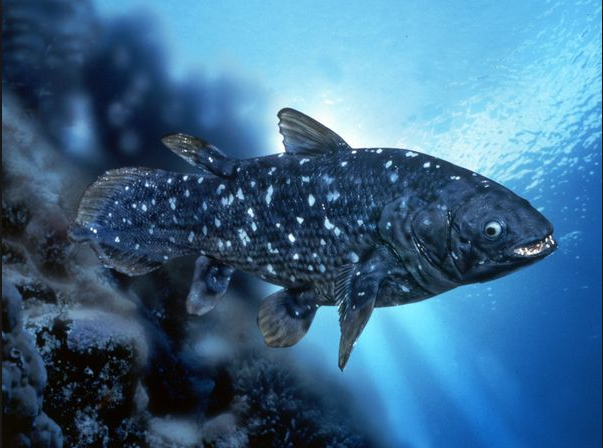
In actuality, in Calcutta on 9 January 1979, in the discourse "The Great Exceptions",  the name Baba has told for the ancient ancestor of fish is "Coelacanth"; this name comes from the Latin Cœlacanthus meaning "hollow spine". The Coelacanth fish still exists today along the coastlines of the Indian Ocean and Indonesia, and is believed by scientists to have evolved into its current form 400 million years ago. (1) There is no fish named Silákantha, but our Tiljala Publishers never bothered to find this out. Rather they would have us believe that this most ancient of fish has a Bengali name.

So TP has concocted the name Silákantha. But the correct name is Coelacanth. All Margiis should please locate their Ananda Vacanamrtam part 8, and correct the passage.

Here below is a photo of this ancient Coelacanth fish:


References
1. Wikipedia - "Coelacanth"

Friday, August 19, 2016

Useless & Bogus Things in AM Books (B)

From: Gopal Roy Choudhary <grchoudhary@bengalcom...>
To: Ananda Marga Discourses <anandamargadiscourses@sunlink.net>
Subject: Useless & Bogus Things in AM Books (B)
Date: Fri, 19 Aug 2016 10:49:37 +0530

BÁBÁ

Useless & Bogus Things in AM Books (B)


Namaskár,

Táraka Brahma Shrii Shrii Ánandamúrti ji has come to this dusty earth and given discourses which are to serve as the dhármika guideline for all human beings. In order for these discourses to fulfill their purpose, they need to be published "As Is", exactly as given by Bábá. Otherwise if mere human beings, with all their imperfections, begin changing the discourses by adding their own additions, then these additions will serve to distort the pure unblemished words of Táraka Brahma.


TP has no clue about the subject matter

For example, on 17 April 1979 Bábá has given the discourse "The History of Ráŕhbhúm", in Kolkata. In that discourse, Bábá has spoken about the grammatical aspects of the Ráŕhii Bengali language. And in that setting, to illustrate the use of the suffix 'ek' [এক্‌] at the end of verbs in Ráŕhii Bengali, Bábá has quoted a poem of Bharatcandra--

Tathástu baliyá Devii dilá baradán,
Dudhe bháte thákibek tomár santán. [Electronic Edition 7.5]

তথাস্তু ৰলিয়া দেবী দিলা বরদান |
দুধে ভাতে থাকিৰেক্‌ তোমার সন্তান || [transcription from audio]

The only reason Bábá has cited this poem, is to illustrate the use of 'ek' [এক্‌] at the verb ending. See in the above poem, the verb 'thákibek' [থাকিৰেক্‌]. Bábá did not discuss the meaning of this poem, and nor does the meaning have anything to do with the subject of Bábá's discourse, which is the use of the suffix ‘ek’ [এক্‌].


It is very painful to see that our Tiljala Publishers are ruining ...

But our Tiljala Publishers have from their own side, printed the English translation of this poem underneath the Bengali version. Bábá did not translate the poem in the discourse, nor did He give any instruction to do so for the published book. This printing of the English translation misleads the readers in a different direction, which Bábá wanted to avoid. But due to ignorance of the subject matter, TP did just the opposite of Bábá’s wishes. And they translated the poem into English. By this approach, they dragged the readers away from the main topic. Because what they have translated, has nothing whatsoever to do with Ánanda Márga ideology. Rather it is a dogmatic poem, the meaning of which goes against AM teachings.

Here is the unnecessary translation TP has printed:

"The goddess Devi granted a boon, saying, 'So be it. Your children will live amidst plenty.'"

So this is one dogmatic poem, conveying the idea upheld by religious Hindus that there are multiple gods and goddesses who give boons to those whom they favor. Bábá had no intention of expressing or highlighting the meaning of this dogmatic poem; He cited it only to illustrate that in Ráŕhii Bengali people append the suffix 'ek' to verbs. By providing the translation, our Tiljala Publishers take the discourse in a completely different direction, misguiding innocent readers by insinuating that Bábá supports the meaning of such dogmatic poems.

It is very painful to see that our Tiljala Publishers translate poems Bábá has given when the meaning has nothing at all to do with Bábá's teachings. The above is only one example; similar examples of poems having irrelevant and dogmatic meanings have been translated by our Tiljala Publishers throughout the published discourses. The irony is that there are hundreds of recorded Hindi discourses yet to be published even the first time. But TP does not publish any of them, hiding under the excuse that they do not have time. And on the other side, by their action it shows they have plenty of time to waste-- they are adding such things to Bábá’s discourses which should not be added. And the nastiness does not end here. Acyutanandji escapes from his publication duties, and runs his website “Right to Life” i.e United States Republican political party agenda, which is a gross misuse of his energy, when Ánanda Márga books are in very bad shape. It shows that he does not have interest in Bábá’s books, rather he has apathy towards them. Otherwise how could he get time to spend all day involved in his private blog on “Right to Life” agenda?


What about other groups of AMPS?

Those who are not aware, “TP” means Tiljala Publications.

What about other factions of AMPS. Are they ok? No, they are equally responsible. Because whatever TP prints, these other factions just reprint it from their own side and append their own name. These other factions do not keep a well maintained publication department. For that reason you see that they are directly selling TP’s books, or are reprinting those very books in their own name and selling them. So in this matter, other factions are equally responsible. So long as these other factions do not come out and express their opinion, it is obvious by their actions that they are 100% in support of the dirty deeds of Tiljala Publications.

Namaskár,
In service to Gurudeva,
Gopal Roy Choudhary

Note: Bábá has given this discourse in Bangla. Those who have deep interest and understand Bangla, if they like they can contact us for the audio.

Note 2: In order to explain the grammar beautifully, Bábá has given more examples along with থাকিৰেক্‌, Bábá has given further examples like ৰললেক্‌, যাৰেক্‌, ৰসিৰেক্‌ in this discourse.

Monday, June 13, 2016

Addendum Sound File: Hindi Discourse falsified as Bangla Download Sound File & Check for Yourself

Click on the below to download the sound file "1979-06-30 Patna "Yogii Avashya Hii Ástik Honge".mp3". The discourse begins with Dada Ramanandji's announcement of the discourse date and place.

Click Here To Download


To read the posting linked with this sound file, click here


The English title of the discourse is "A Yogi Must Certainly Be A Theist."