Wednesday, October 12, 2016

AM book distortion: section on women is deleted

BÁBÁ
AM book distortion: section on women is deleted
Namaskár,
The below excerpt on women’s rights is missing from the printed English and Bengali versions of Bábá's discourse, "Liberation of Intellect". The discourse was originally given by Bábá in Hindi. And the original Hindi of the missing section is given below in English translation. So here follows this important Ananda Marga book distortion in which the section on women has been deleted.
Translated from the original Hindi "Liberation of Intellect" (Patna, 26th January 1980)--
English translation of the deleted section of the discourse
(Note: The following section, highlighted in yellow, is an informal translation of the missing section of "Liberation of Intellect" [Patna, 26th January 1980]. This section on women has been deleted by our Tiljala Publications (TP) department, and it continues to be missing from our English Ananda Marga books even today.)
The original Hindi of the below has been transcribed from the audio file of Bábá's discourse.
Bábá says in the "As Is" discourse--
"There are also a few "great personalities" (maha'purus') - we call them "great personalities" because it would not be proper to use any other term - who say that in the social sphere one woman does not hold the value of an entire man. Rather, three women equal one man. What an absurd notion! Those who are the followers of such "great personalities", their own intellectual growth will be impeded. They will not be able to tolerate even, any rational ideas. They will keep away from and fear all rational ideas which bring the natural growth and development of mind. In this very way, dogma has captured their minds.”
“Some people also say that-- ‘In religion, there is no place for the intellect’. That is, where people are not intelligent, where they are not rational, where they are fools, in that very state they are liable to get caught in the clutches of religion.”
“The subject of today's discourse is, ‘The liberation of intellect’. Indeed, we have to utilize our intellect in all spheres of life. And because of this, we want to increase our intellect as much as possible. Further we know that, according to the law of nature, human intellect will go on increasing. And, dogmas will continue to hinder this mental progress for many more years to come. I will say this to you all that you have understood well what is dogma, and what is not. And I will also say, that wherever you see dogma creating a hindrance to the growth of your intellect, there you should courageously go on crushing the dogmas and moving ahead!" (1)
Here ends the missing section of "Liberation of Intellect" (Patna, 26th January 1980). This important section on women has been deleted by our Tiljala Publishers, and it is still missing from our English AM books today. Again, the above is an informal translation of what Bábá has said in His original Hindi discourse.
Why yellow section was removed BY TP
Indeed, perhaps the most important section of the discourse, about the rights of women, has been deliberately taken away. This was done in order to shorten the length of the discourse-- so that in the long term, the number of printed pages in AM books would be less in Hindi and more in Bangla. So that Bangla would supercede Hindi altogether and be accepted as the most important language in Ananda Marga scripture. And the proof that Dada Sarvatmananda had this desire, is that this was done not with one discourse only, but with many. This became the overwhelming trend in our Tiljala Publications department, that any discourse in Hindi should be shortened as much as possible. For proof, see books AV-1,2,3 etc.
Unethical history of Dada Sarvatmananda
And this discourse "Liberation of Intellect", although given by Bábá in Hindi, was actually printed first in Bengali in AV part 18. And Bangla was presented to the Márgii public as the original language of the discourse. This very Bengali language edition was used by our publishers as the original also-- that is, Hindi and English editions were translated from this so-called "original" Bengali version. Although Bábá had given the discourse in Hindi, but the translated Bengali version was used to re-translate a new Hindi version, rather than using the original Hindi which Bábá gave the discourse in. So the Hindi and English editions of the discourse when they were later printed, were translated from Bengali. And it is even printed in the Hindi and English editions, that the discourse is "Translated from the original Bengali". And any subsequent other-language editions whether Spanish, Russian, Japanese etc, were all translated from the so-called "original" Bengali-- when actually this was not the original at all. The Hindi was the real original, but our Calcutta publishers befooled the Márgiis and general WTs into thinking that the Bengali version was the original. So in that very so-called original Bengali printing, the section about women's rights was removed. This was done out of a desire to minimize the Hindi discourse-- for in their own minds, our publishers knew that Bábá had given the discourse in Hindi and for this reason they wanted to minimize it. So they removed the section about womens' rights. And Márgiis were not aware, no one could know that anything was missing from the English and Bengali publications of the discourse. There was no note about it in the book, nothing at all was mentioned. And in these many years since then, the discourse has remained just like that. After the first printing, it was later published in "A Few Problems Solved" in 1987. Several years had passed since the first AV-18 printing, but still the section on women's rights remained missing in the English and Bengali publications of the discourse. And this is a major discourse-- "Liberation of Intellect". It is the very first discourse in the Neohumanism series.
In Him
Lalita’ Basu
For detailed study
From "Liberation of Intellect" (Patna, 26th January 1980). Here follows the As-Is original Hindi of the aforesaid yellow.
“दो चार महापुरुष भी तो ऐसे थे, (हम तो महापुरुष कहते हैं क्योंकि और शब्द का व्यवहार करना, उचित नहीं होगा) कहते थे, कि---"एक औरत एक पूरा मनुष्य नहीं है | तीन औरत समान एक पुरुष |" अद्भुत logic ! और जो लोग उनको मानेंगे, उनकी बुद्धि पर अवरोध डाला जाएगा | वे दूसरे किसी प्रकार का विचार, {जो} वे बर्दाश्त तक नहीं कर सकेंगे | जिस विचार से मन का स्वाभाविक विकाश होगा, बुद्धि का स्वाभाविक विकाश होगा, उस विचार से वे दूर रहेंगे, विचार से डरेंगे | Dogma उनको इस तरह से जकड़ लिया है |
कुछ लोग तो ऐसा भी कहेंगे कि---"मज़हब में अक़्ल का दख़ल नहीं है" | अर्थात्‌ जहाँ अक़्ल नहीं है, जहाँ मनुष्य अक़्ल मन्द नहीं है, जहाँ मनुष्य विचारशील नहीं हैं---वे मज़हब के चङ्गुल में फँसेंगे |
आज का आलोच्य विषय है---"बुद्धि की मुक्ति" | जीवन के हर पहलू में हमें बुद्धि से काम लेना पड़ता है | और हम अधिक से अधिक बुद्धि चाहते हैं, चाहेंगे | और हम जानते हैं, प्राकृतिक विकाश के अनुसार मनुष्य की बुद्धि बढ़ती रहेगी | और इस बुद्धि के परिवर्त्तन में और भी कई सालों तक ये जो dogmas हैं, बाधा डालती रहेंगी | हम तुम लोगों से यही कहेंगे, कि तुम लोगों में यहाँ तक बुद्धि तो आ गई है कि कौन dogma है, और कौन dogma नहीं है | यह समझाने की बुद्धि तुम में आ गई है | हम यहीं कहेंगे कि जहाँ देखोगे---तुम्हारी बुद्धि के विकाश में dogma बाधा डाल रही है, वहाँ हिम्मत के साथ dogma को चूर-चूर कर आगे बढ़ते रहो | “ (2)
Electronic Edition also missing deleted section
Below is the 2009 Electronic Edition. The section marked in yellow is where the deleted section is missing. The missing section should have begun immediately following the words marked in yellow.
 (3)
                                                                                                                                
Note 1: Aforementioned yellow para missing from the following books
The missing section where Bábá exposes the dogma about three women equaling one man has been removed from the English and Bengali version of the discourse. That is why that para does not appear in any of the following books:
(1) NHNS-1, '87 Edn, English
(2) NHNS-1, '99 Edn, English
(3) AV-18, '80 Edn, Bangla
(4) AFPS-4, '87 Edn
(5) Electronic Books (EE 7.5)
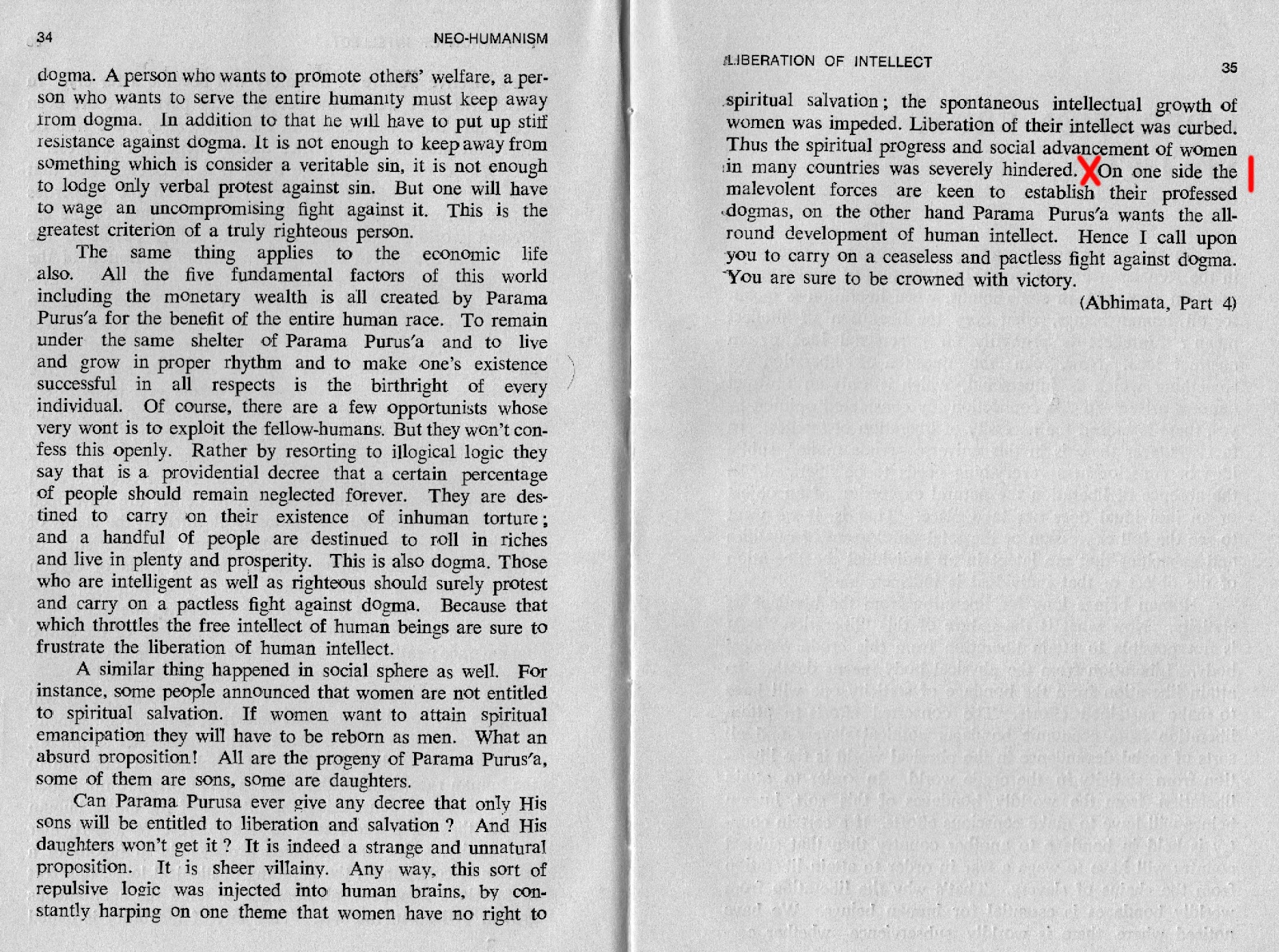
The missing section would be just before the final paragraph of the English version of the 'Liberation of Intellect' discourse. So it would appear just AFTER the words "severely hindered in many countries.", and just BEFORE the opening words of the last paragraph, "On one side the malevolent forces".
Section related with women is missing from the book NHNS(E) part I
Below is a scan of Neohumanism in a Nutshell part I. The final paragraph on p.35 marked in red is where TP has removed the important section which was about women’s rights. The missing section would have begun at the red ‘X’ mark.
Liberation of Intellect pp.34-35 w-x-mark.jpeg
                                                                                                                                                          (4)

“Three women equal one man”-- This very dogma exposed by Bábá was removed from the book.
Note 2: Bábá says, where one is being pointed out for a mistake, "If there is even a little fault in you, you should keep your mouth closed and accept it all, and you should thank the person for pointing our your fault and request punishment." (5)
But instead of accepting their mistake, TP may give the preposterous and lame excuse that, "Oh, what can we do? The audio cassette was stolen." So watch out. Everybody knows that they have all the cassettes.
Bábá says, where one is being pointed out for a mistake, "If there is even a little fault in you, you should keep your mouth closed and accept it all, and you should thank the person for pointing our your fault and request punishment." (5)
Note 3: In order to make Bábá’s books pristine, please forward this posting to the respected Tiljala Publications Secretary, dada Mantreshwarananda ji <Mantreshwarananda@hotmail.com>, and to respected dada Acyutananda ji, <acyutananda1@gmail.com>.
References
1. As-Is version, "Liberation of Intellect", Patna, 26th January 1980. Translated from original Hindi.
2. As-Is version, "Liberation of Intellect", Patna, 26th January 1980. Original Hindi.
3. Tiljala Publications, "Liberation of Intellect", Patna, 26th January 1980, 2009 Electronic Edition.
4. Tiljala Publications, "Liberation of Intellect", Patna, 26th January 1980, Neohumanism in a Nutshell (E) part I.
5. Ananda Marga Caryácarya Part 2, point 20.
== Links ==
Recent postings

Sunday, September 18, 2016

Example: Distortion in AV34

Bábá

Example: Distortion in AV34-21


Namaskar,

1. The discourse "Revolt Against Dogma" was given by Bábá in Kolkata in 1981. (1) It is published in Ánanda Vacanámrtam part 34, ch 21.

To understand very easily, please follow the color code---(A) The yellow color represents the “As Is” version. (B) The light red color is the version printed by our Tiljala Publishers (TP). (C) The dark red text is the display of distortion in a concentrated way.

2. Now first see what Bábá actually said on that occasion. This is from the As-Is version, and is highlighted in yellow:

Bábá says in the "As Is" discourse-- “For [the] devotional approach, nothing external is required; nothing external is required to be done. And the supreme apex of this true spirit of devotionalism is Ánanda Márga. And because it is the supreme pinnacle of devotional approach, you should remember that victory is yours, because Parama Puruśa is cent per cent yours.”

Again please see, and pay special attention to the red section, which has been removed by our Tiljala Publishers (TP):

"For the devotional approach, nothing external is required; nothing external is required to be done. And the supreme apex of this true spirit of devotionalism is Ánanda Márga. And because it is the supreme pinnacle of devotional approach, you should remember that victory is yours, because Parama Puruśa is cent per cent yours."

3. Now see here how our Tiljala Publishers printed this section in Ánanda Vacanámrtam part 34, chapter 21 of Bábá’s books:

Our Tiljala Publishers (TP) have printed---“For the devotional approach, nothing external is required; nothing external is required to be done. And because it is the supreme pinnacle of devotional approach, you should remember that it is yours, because Parama Puruśa is cent per cent yours.”

4. So see the above para, how our Tiljala Publishers removed Bábá’s original words, that is, the following portion which is highlighted in red: And the supreme apex of this true spirit of devotionalism is Ánanda Márga.


Why Sentence Removed

Why was this sentence removed by our Tiljala Publishers? The reason is quite obvious. They are ashamed and embarrassed to publicly highlight Ánanda Márga philosophy as being the height of spirituality. They are too concerned about what others will think. So they deleted that section.

The unfortunate fact here is that our Tiljala Publishers felt it was an outrageous statement that Ánanda Márga philosophy is the culmination of spirituality, so they left out the sentence altogether. In the same way, some cowards do not like to hear people say that Shrii Shrii Ánandamurti jii is Parama Puruśa.

And in the same way our Tiljala Publishers think, "What will non-Márgiis say when they read these things like-- And the supreme apex of this true spirit of devotionalism is Ánanda Márga."  So, they leave out such points wherever found in the discourses. The present case is one such example.

Namaskar,
In service to Gurudeva,
Jyotiisha

Footnote:
1. Key--
(A) “Tiljala Publishers (TP) have printed” = refers to any Ananda Marga book which is printed by Tiljala Publications. It may be in physical book form, or in electronic form.
(B) “As-Is” Version = means direct transcription from Baba’s audio.
2. The full text of the passage as printed by our Tiljala Publishers can be seen on our blog at this link.


Ready-Made Excuse of Tiljala Publishers

There is one other very important thing you must know about this entire situation. Our Tiljala Publishers have incorporated one ready-made excuse into their plan. If anyone raises this matter with them and asks why certain key words are missing, then our Tiljala Publishers will say, “It was inaudible on the original cassette.” This is what our Tiljala Publishers repeat.

Here then is the “As Is” version of that section of Guru’s discourse again--

Bábá says in the "As Is" discourse--“For [the] devotional approach, nothing external is required; nothing external is required to be done. And the supreme apex of this true spirit of devotionalism is Ánanda Márga. And because it is the supreme pinnacle of devotional approach, you should remember that victory is yours, because Parama Puruśa is cent per cent yours.”

Again please see the above para, and pay special attention to the red section, which has been removed by our Tiljala Publishers


Ánanda Márga Scripture Not Being Protected
Therefore Responsibility Falls to Ánanda Márgiis

Bábá says, “The scriptures containing spiritual injunctions must be totally flawless.” (3) So as Ánanda Márgiis, we must take this very seriously and work together to make the printed version of Bábá's discourses perfect. By such examples as the above, it becomes clear we cannot merely sit back and expect that with time the Tiljala Publishers will fix everything.

Thirty five years have passed since this discourse was given in 1981; There have been multiple editions published, with no sign of fixing the discourses going on. The Tiljala group whatever they spend all their time and resources on these days, if instead they had utilized these in fixing Bábá's discourses, then their efforts would have been worthwhile. When our Publishers are not fixing the discourses, then it falls upon Ánanda Márgiis to come forward, create pressure for change, and help in the rectification of our scripture.


== Links ==

Recent postings


Note: In order to make Bábá’s books pristine, please forward this posting to the respected Tiljala Publications Secretary, dada Mantreshwarananda ji <Mantreshwarananda@hotmail.com>, and to respected dada Acyutananda ji, <acyutananda1@gmail.com>.

References.
1. As-Is Bábá’s Discourse, “Revolt against Dogma,” Ánanda Vacanámrtam Part 34, chapter 21. 18 May 1981, Calcutta.
2. Tiljala-printed Publication, “Revolt against Dogma,” Ánanda Vacanámrtam Part 34, chapter 21. 18 May 1981, Calcutta.
3. Namah Shiváya Shántáya, Disc: 14

These respected dadas may be known by the following spellings as well: Mantreshwarananda ji, Mantreshwaránanda, Mantreshwaranand, Mantreshvarananda, Mantreshvaranand. Acyutananda, Acyutanand, Acyutánanda, Acyutanand, ÁAA

Saturday, September 17, 2016

"Ánanda Márga supreme apex of devotionalism" = left out of Tiljala Publishers' (TP) Discourse

Our Tiljala Publishers (TP) have printed the following as the final paragraph of the discourse “Revolt against Dogma,” Ánanda Vacanámrtam Part 34, chapter 21. 18 May 1981, Calcutta. In so doing, TP has left out the following key section from the final sentence which Baba spoke-- "And the supreme apex of this true spirit of devotionalism is Ánanda Márga". This is missing from the final sentence of the below para printed by TP.

Our Tiljala Publishers (TP) have printed---

"Even in the realm of the actional faculty or the intellectual faculty, or even the so-called devotional faculty, everything is not dharma, everything is not a perfect approach. There are also colours of dogma in them. So those who are spiritual aspirants should very carefully keep themselves away, rather keep themselves aloof, from these so-called approaches of spirituality, rather, from these dogmas. In the past there was dogma; in the Middle Ages it reached its zenith; and in the Middle Ages of the human era, of human history, there was a revolt against dogma. That first revolt against dogma was a psychic approach, a psycho-spiritual approach, of devotionalism. And that we find in certain Bhágavata shástras [scriptures], where they say that no physical show is required for the devotional approach. For the devotional approach, nothing external is required; nothing external is required to be done.*  And because it is the supreme pinnacle of devotional approach, you should remember that it is yours, because Parama Puruśa is cent per cent yours." (1)

*In this location, the sentence which Baba speaks, "And the supreme apex of this true spirit of devotionalism is Ánanda Márga" has been removed by our Tiljala Publishers.

To see the full posting on this subject, click here.

References
1. Tiljala-printed Publication, “Revolt against Dogma,” Ánanda Vacanámrtam Part 34, chapter 21. 18 May 1981, Calcutta.

Friday, September 9, 2016

Discourse distortion AV-3: North Pole changed to Nagpur

BABA

Discourse distortion AV-3: North Pole changed to Nagpur


Namaskár,

Bábá says in the "As Is" discourse--- "In North Pole You may ask, 'Mahámáyá, oh Mahámáyá, I want a mango,’---then and there, it will be present there."

Our Tiljala Publishers (TP) have printed---"In Nagpur You may say, ‘Oh, Mahámáyá, I want a mango,’ and then and there it will be furnished."

Conclusion: TP changed “North Pole” to “Nagpur”.

*********
If the point raised is unclear, please go on reading.


Distortion AV-3: Detailed version is below

Bábá has given the discourse “Prańáma Mantra” in Patna on 5 October 1978, in Patna. Our Tiljala Publishers have printed that discourse in Ananda Vacanamrtam part 3, where it is discourse #5. And there in one section, our Tiljala Publishers have printed the following line--

Our Tiljala Publishers (TP) have printed---"In Nagpur You may say, ‘Oh, Mahámáyá, I want a mango,’ and then and there it will be furnished."

Comment: Here, the word 'Nagpur' is concocted by our Tiljala Publishers. And this imaginary word “Nagpur” is undermining the uniqueness of Mahámáyá (all-pervading Maya). Because in Nagpur, the common man can effortlessly get Mangos. So if Mahámáyá furnishes a mango in Nagpur, that is not a big thing. That is why Bábá did not give the term ‘Nagpur’; it is obviously fictitious.

The actual words Bábá has spoken at this point in the discourse, are the following--

Bábá says in the "As Is" discourse-, "In North Pole You may ask, 'Mahámáyá, oh Mahámáyá, I want a mango,’---then and there, it will be present there."

Comment: Bábá is describing a situation in which, in the North Pole, Mahámáyá is requested to furnish a mango. It is not a joke for common people to produce a mango immediately in the North Pole. But Mahámáyá with Her all-powerful nature, then and there furnishes a mango at the request of Parama Purusa.

Here in place of Bábá's actual word 'North Pole', our Tiljala Publishers have printed 'Nagpur'. So if Mahámáyá furnishes a mango in Nagpur, that is not a big thing. This imaginary word “Nagpur” is undermining the uniqueness of Mahámáyá (all-pervading Maya). On this very point, our Tiljala Publishers' version is not only not what Bábá said, but it is nonsensical. Here the main damaging distortion, is 'Nagpur' in place of 'North Pole'.

In summary: By printing ‘Nagpur’ in place of ‘North Pole’ the entire subject becomes ludicrous and meaningless. This underscores how critically important it is that Bábá's published discourses be "As Is". They must contain the precise words Bábá Himself has said, and should not contain these sorts of misleading distortions introduced by our publishers.

Bábá says in the "As Is" discourse--- "In North Pole You may ask, 'Mahámáyá, oh Mahámáyá, I want a mango,’---then and there, it will be present there."

Conclusion: TP changed North Pole to Nagpur

The mistake is obvious.

Namaskar,
In service to Gurudeva,
Krishna Ganguli


And there are many other words as well in this discourse which by comparing with the “As-Is” discourse, you will find changed in the TP printed version.

Note 1.

Fix Bábá's Discourses Now or Never

If we remain passive onlookers and do not fix the negative trends of introducing distortion into Shrii Shrii Ánandamúrtiji's discourses—if we do not bring the printed discourses up to the proper standard now—it will become impossible to change this in the future. And even if in future some sincere Ánanda Márgiis will try, they will be treated as enemies. Because this is the way religion works: Today one cannot teach the devotees of Lord Krśńa that He has nothing to do with cows; they will never believe it. In the same way, Ánanda Márgiis will become used to the wrong teachings in our AM books and they will not like to give them up. They will think that whatever was there at the end of the twentieth century, that was the gold standard for all time. And it should be kept and maintained.

Ánanda Má́rga is dharma—not religion—but we will face the same opposition from within to change, when wrong teachings get established.

So we don't have any time: it is either now or never. The clock is ticking: If we do not get Bábá's discourses fixed now, it will be impossible to do so later. And that will cause bloodshed and more division on the basis of the various versions of Bábá's teachings and their explanations. History bears testimony to this, that all the religions have similarly broken into multiple factions, groups and subgroups on the basis of differences in scripture interpretations. Although Ánanda Má́rga is dharma—not religion.

Bábá wanted to eliminate such problems, and that is why Bábá's discourses are recorded. But unfortunately, those recordings are not being published properly. This matter is very serious.


Larger Section of material which is printed by TP in AV-3, Ch-5.

Our Tiljala Publishers (TP) have printed---
“O Lord, Thou art the creator of this universe. This universe is full of gems and jewels. So do You require anything from a poor man like me? Nothing. All the gems and jewels, everything, all the wealth of the world, belongs to You. And Your grhińii, Your spouse, is Mahámáyá. She is Your spouse, and according to Your order and desire She will supply You with anything. In Nagpur You may say, ‘Oh, Mahámáyá, I want a mango,’ and then and there it will be furnished. Mahámáyá is Your spouse, so there cannot be any want, there cannot be any shortage in Your store. So what shall I offer to Thee? I have heard that Your big devotees, by their strong devotion and love for You, have snatched away Your Mind, have taken away Your Mind. I am not a big devotee. The big devotees have taken away Your Mind. You have lost Your Mind. So there is a shortage of one thing, a shortage of mind. But Lord, You needn’t be disappointed. I have a mind with me – take that mind. I offer it to Thee.”

== Links ==

Recent postings


Note: In order to make Bábá’s books pristine, please forward this posting to the respected Tiljala Publications Secretary, dada Mantreshwarananda ji <Mantreshwarananda@hotmail.com>, and to respected dada Acyutananda ji, <acyutananda1@gmail.com>.

References
1. As-Is Bábá’s Discourse, “Prańáma Mantra”, Ananda Vacanamrtam part 3 discourse #5. 5 October 1978 Patna.

2. Tiljala-printed Publication,  “Prańáma Mantra”, Ananda Vacanamrtam part 3 discourse #5. 5 October 1978 Patna.

Monday, September 5, 2016

Bengalization: Blunder In SS-11


Date: Mon 5 Sep 2016 10:12:49 -0000 (GMT)
From: Biresh Mitra <m_mitra@link-net...>
Subject: Bengalization: Blunder In SS-11
To: Ananda Marga Discourses <anandamargadiscourses@sunlink.net>

BABA

Bengalization: Blunder In SS-11


Namaskar,

In the DMC discourse “The Supreme Desideratum of the Microcosms,” given in Hindi on 26 November 1978 in Bombay, our Tiljala Publishers made a serious mistake in the translation for the English edition. For the details of that mistake see below.

In His ‘As Is’ discourse, SS-11, Bábá says--

"संहार करनेवाले भी तुम्हारे पिता, और रक्षा करनेवाले भी पिता, तो बच्चे डरेंगे क्यों ? बाघ से और लोग डर सकते हैं, बाघ के बच्चे डरते नहीं हैं |"

The sense of the above Hindi is that----
"Your father Parama Purusa is the Destroyer as well as the Savior, so as His child, why should you be afraid of Him? Similarly the public may be afraid of a tiger, but the tiger's own cubs are not afraid of him."

See below the corresponding passage from the very same discourse, as published by our Tiljala Publishers in the Electronic Edition 7.5. It is from “The Supreme Desideratum of the Microcosms”, 26 November 1978 DMC, Bombay, printed in Subhasita Samgraha part 11--

"Just as the Destroyer is your Father, the Preserver is also your Father and why should the offspring be afraid of their Father? A father may be feared by others, but why should the sons and daughters be afraid of their father?"

Our Tiljala Publishers translated the original Hindi discourse into Bengali and from that Bengali, they translated into English. And in this lengthy process of double translation, Bábá's teaching about the tiger was completely lost. This is call Bengalization.

Conclusion

Bábá says in His original discourse-- “The public may be afraid of a tiger, but the tiger's own cubs are not afraid of him."

The Tiljala Publishers printed-- “A father may be feared by others, but why should the sons and daughters be afraid of their father?"

So the flaw is very obvious.

Namaskar,
In service to Gurudeva,
Biresh Mitra


Spiritual injunctions must be totally flawless

Verily, to change words in the publication of a discourse, alters the meaning and misguides readers. Táraka Brahma has given pristine, clear teachings. Mis-transcription and double translation opens the door to misinterpretation and dogma.

Bábá says,

"In the spiritual world, there should not be anything which will divert human beings from the path of synthesis to that of analysis, which will provoke divisive tendencies and restrict collective existence within narrow confines.”

“Nothing should ensnare people in the illusory net of pettiness in any sphere of life, from the general code of spiritual conduct to the universal and eternal principles of life – lest the voracious fangs of the all-consuming Máyá devour them. Thus the scriptures containing spiritual injunctions must be totally flawless.” (NSS, Disc: Shiva's Teachings – 2 (continued) (Discourse 14)

Sunday, September 4, 2016

Saḿskrta Must Be Revived--Baba


Subject: Saḿskrta Must Be Revived--Baba
Date: Sat, 3 Sep 2016 11:55:42 +0530
From: tr sukul <trsukulsagar@...>

BABA

Saḿskrta Must Be Revived--Baba

Many eminent scholars claim that Saḿskrta is the mother of most of the languages of the world. If we contemplate Rev. Baba's discourses, we find that the human civilization started about 15,000 years ago with the Rk Veda. The Rgvedic period continued up to 10,000 years ago and then originated the Yajurvedic age. During those days one almost identical language was current all the way from Central Asia and Eastern Europe to Southeast Asia. The branch of that language that was popular in Southeast Asia was called Saḿskrta, while the language spoken in the northeastern parts was Vedic. (1)

This simply indicates that Saḿskrta/Sanskrit is an ancient language and that other languages originated from it and varied according to the time, space and environment. Many scholars claim that the important words of Saḿskrta have been found common in different languages (especially Indo- European) of the world, hence they opine to say that Saḿskrta is the mother of most other languages. In this computer age many scholars have found that the algorithm and programming is comparatively easy using Saḿskrta grammar rules.

Strong will power needed to make Saḿskrta a live language

In this perspective, is it not our duty to place our grandmother Saḿskrta at her proper seat? We have neglected this fact and made Saḿskrta as a dead language. Rev. Baba has given an example in Varna Vicitra Vol 3 of how Hebrew was a dead language that was revived with the resettling of Jews in Israel. Baba continues to state how the same is the case with Saḿskrta and how Saḿskrta should be revived and made into a living language. Old Arabian and Hebrew are sister languages. Centuries ago Hebrew was eradicated from the soil of Israel and became as dead as old Arabian. With the rebirth of the new Israel, it was the will power of the country that they could revive Hebrew and restore it to its proper position declaring it the state and official language.  

Baba has asked of those who have declared Saḿskrta as a dead language, to what extent they are right when they borrow words, expressions, pronunciation and thoughts from it every day? Is it not our moral duty to make efforts to revive our grandmother tongue Saḿskrta and give her a suitable place in our day to day life? Should we not learn the lesson from Israel regarding the revival of Hebrew? Samskrta should be revived in the same way. (Varna Vichitra-3 point 10 page 21-22)

Regards,
In His lotus feet
Dr T. R. Sukul.

1. Namah Shivaya Shantaya, Disc 1.
2. Varna Vicitra-3, Hindi edition, Point 10 page 21-22. Discourse originally given in Bengali.