Friday, May 26, 2017

Watch out: Distortion in Subháśita Saḿgraha 12 ...

BÁBÁ


Watch out: Distortion in S-12, Ch-4(E)

Namaskár,

It is sad that in our Ánanda Márga books, distortion is quite common. If you read carefully, you can catch the locations of distortion yourself-- you'll feel that "something is wrong here". When in the para certain ideas are missing, then the para becomes convoluted. And in result, readers cannot understand the subject. Due to this, often readers just think in their mind that "The subject is too tough, that's why I cannot understand." And thinking this, either they skip the para or stop reading. But in reality the main cause of such convoluted sections in the discourse is distortion-- distortion which may have been brought about by the publishers knowingly or unknowingly. And often, due to this distortion, the subject matter becomes convoluted.

Here below is one significant example. The discourse “How an Ideal Person Should Live” has been given by Bábá in Bangla in Calcutta, in 1979. The discourse was published in Bangla in Subháśita Saḿgraha part 12 chapter 4, and from there was translated into English and published in the English version of the volume, SS12-04 (E).


Analogy of dying lady left out (see yellow)
(of S-12 Ch-4 (E) book)

Near the end of the discourse, a large two-page section of the original published Bangla version was left out en bloc from the English publication. To give English readers a sense about the meaning of the left out section, here below is the rough idea of one small para from that large left out section. It represents a mere 15% of the total missing section. I’ve written this small portion in English myself, to give you a sense of what is missing:

Bábá says in Bangla, In one family, the grandmother was on her deathbed. All her grandsons, granddaughters, and entire family of kith and kin, had come to pay their last visit. All were surrounding her. The grandmother was busy asking them about what has been cooked, whether the room has been swept or not, and whether everyone has taken bath or not. Hearing this, the family members requested, “Ma!, Shanta Hari Hari.” She ignored this, and asked her next question as to whether the cows are being fed or not. All wanted that Grandmother should repeat the name of Hari so that she will get salvation. So they reminded her again, “Ma, all house chores are happening daily. So you need not worry about that. Just chant the name of Hari.” Grandmother ignored them and went on to ask whether the animals had been fed. Then again her relatives requested, “Ma! Hari Hari.” Hearing this, the old woman got frustrated. She yelled at everyone, “Get out from here, such a long name I cannot recite.

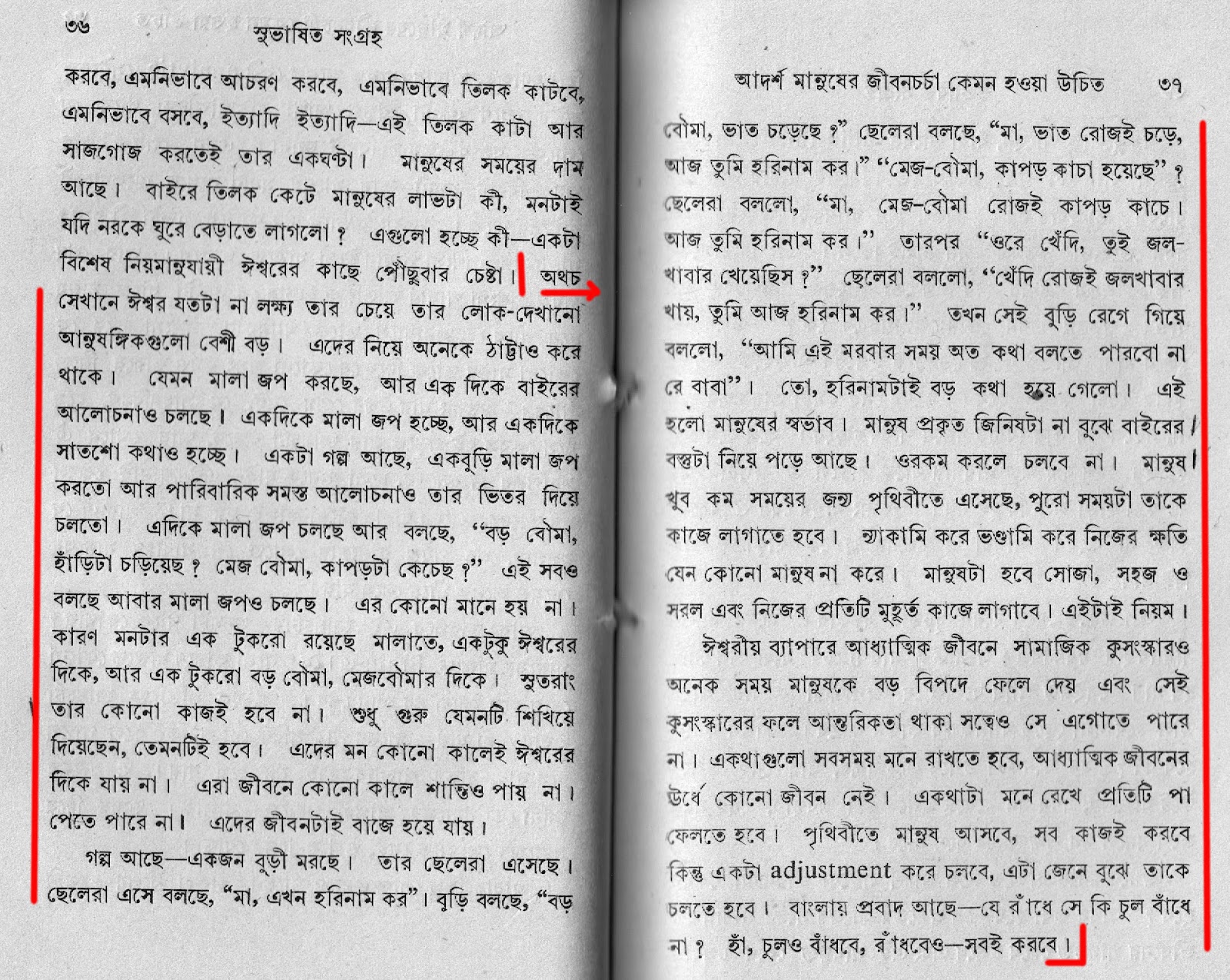
Here below is a scan of the published Bangla discourse “How an Ideal Person Should Live”, with a red line outlining the section that is missing in the English edition. The entire section starting with the red line on the left hand page, and extending through the remainder of the left side page as well as the entire right side page from top to bottom, is missing from the English edition. (To see the scan of the English edition where the below large section is left out, please scroll down.)

See below scan of Bangla edition of SS12-04 (B), showing in red, the section which is missing from English edition (English scan further down below.)

SS12-04 Ádarsha Mánuśer Jiivanacaryá Keman haoyá ucit w-red line.jpeg

                                                                                       (1)
See above scan of Bangla edition of SS12-04 (B), showing in red, the section which is missing from English edition (See the below English scan.)

This discourse “How an Ideal Person Should Live”, is very poorly translated from Bangla to English. It may be that there are a number of such large sections missing from the English edition.


Conclusion: careless translation

Baba delivered the discourse in Bangla. And in the Bangla version of the published discourse it is printed properly. But our Tiljala Publishers carelessly translated it into English. And in so doing, they left out approximately 30% of Baba’s spoken discourse. It is sad that this type of carelessness is going on. We have to save the discourses of our Guru Shrii Shrii Anandamurti ji. It is obvious that depending on our Tiljala Publishers, is not a good idea.  

Namaskar,
In Him,
Biresh Mitra


Ánanda Márga Scripture: Responsibility of Ánanda Márgiis

Bábá says, “The scriptures containing spiritual injunctions must be totally flawless.” (3) So as Ánanda Márgiis, we must take this very seriously and work together to make the printed version of Bábá's discourses perfect. By such examples as the above, it becomes clear we cannot merely sit back and expect that with time the Tiljala Publishers will fix everything.

Márgiis have been pointing out to our Tiljala Publishers, the distortions in our publications for years, but there is no sign of fixing the discourses going on. The Tiljala group whatever they spend all their time and resources on these days, if instead they had utilized these in fixing Bábá's discourses, then their efforts would have been worthwhile. When our Publishers are not fixing the discourses, then it falls upon Ánanda Márgiis to come forward, create pressure for change, and help in the rectification of our scripture.


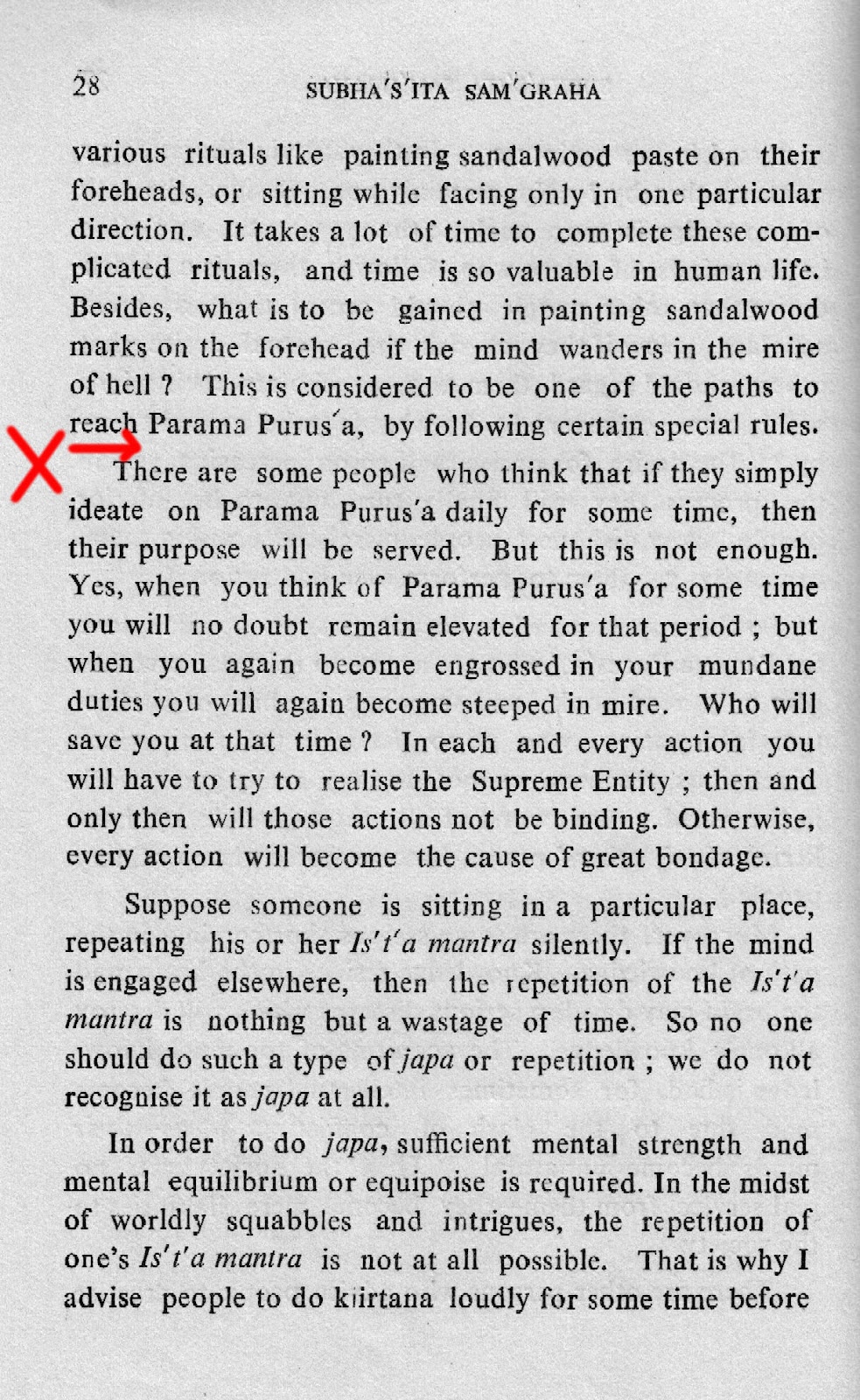
Note 1: Here below is a scan of the page of the English edition of SS12-04 (E), from which several of Baba’s paragraphs are missing. In this missing section, Bábá has given a very lucid story related with dying patients, in addition to important related teachings. But unfortunately, due to distortion that story and its associated teachings have been lost from the English printing of the discourse SS12, ch 4. Please see the below scan. The red mark indicates where the large section spoken by Baba should have appeared; but it is missing.

See below scan of English edition of SS12-04 (E), showing in red, the location of large missing section

SS12-04 How an Ideal Person Should Live w-red 'x'.jpeg
                                                                                      (2)

See above scan of English edition of SS12-04 (E), showing in red, the location of large missing section

Note 2: In order to make Bábá’s teachings distortion-free, please forward this posting to the respected Tiljala Publications Secretary, dada Mantreshwarananda ji <Mantreshwarananda@hotmail.com>, and to respected dada Acyutananda ji, <acyutananda1@gmail.com>. As well, please send this posting to <hariishananda@gmail.com> and <acaryarudrananda@gmail.com>.

Note 3: S-12 and SS-12 both refer to Subháśita Saḿgraha.

References
1. Tiljala Publications, "Ádarsha Mánuśer Jiivanacaryá Keman haoyá ucita" , Subháśita Saḿgraha part 12, ch 4.
2. Tiljala Publications, “How an Ideal Person Should Live”, Subháśita Saḿgraha part 12, ch 4.
3. “Shiva's Teachings – 2 (continued)”, Namah Shiváya Shántáya

== Links ==

Recent postings


Mantreshwaranand, Mantreshvarananda, Mantreshvaranand, Mantreshvaránanda, Acyutananda, Acyutanand, Acyutánanda, Hariishanand, Hariishánanda, Rudrananda, Rudranand, Rudránand

Wednesday, April 5, 2017

Dimdiha distortion

Baba

Dimdiha distortion

Namaskar,
Please pay attention to the following two quotes - one highlighted in yellow and one in green. These quotes are from our Ananda Marga books, but, unfortunately, the yellow quote contradicts the green quote, and vice-versa.

The overall idea of the yellow quote is that a volcanic eruption occurred in the Ananda Nagar region nearly 1 million years ago and the lava and debris created mass destruction in the local area. The villagers were terrified by this catastrophe and could not understand why this happened. So they concluded that goddess Candii is furious and she is burning us with fire. This is the overall idea of the quote highlighted below in yellow.

QUOTE #1: Ananda Marga philosophy says, “About 900,000 to one million years ago, the top of the Dimdiha Hill, near Anandanagar, was blown off by a volcanic eruption. The debris fell within a radius of about two miles, killing all of the people and animals living there. Due to the abrupt change in temperature, they were fossilized. Uneducated people called this explosion the work of the goddess Candii. This kind of [[volcanic]] eruption is called “jvala-mukhi” in Saḿskrta.” (1)

That concludes yellow quote; now see the green quote.

The overall idea of the green quote is that goddess Candii is a mythological figure that came into existence around 1300 to 1400 years ago. So goddess Candii is a very recent creation. Before 1400 years ago, nobody even knew of the name goddess Candii because the Candii goddess did not even exist.  This is the overall idea of the quote highlighted below in green.

QUOTE #2: Ananda Marga philosophy says, “The worship of the goddess Durgá is based mainly on the Márkańd́eya Puráńa, and to a lesser extent on the Devii Puráńa, the Káliká Puráńa, the Brhatnandikeshavara Puráńa, the Duragábhaktitaraunginii, the Deviibhágavat, etc. None of these books is older than 1300 or 1400 years. Seven hundred shlokas [couplets] were collected from those books and gathered together, and that constituted the abridged Márkańd́eya Puráńa, which is also known as Durgásaptashatii, or more colloquially, Shrii Shrii Cańd́ii. None of these works existed at the time of Shiva.” (2)

That concludes the green quote. Now see the conclusion.


Conclusion

[A]  The quote - highlighted above in yellow - projects the idea that 1 million years ago terrified villagers of the Ananda Nagar region attributed the volcanic eruption and destruction to goddess Candii.

[B] The quote - highlighted above in green - projects the idea that goddess Candii came into existence only 1400 years ago.

[C] Hence, the above yellow and green quotes are contradicting each other. The yellow quote claims that goddess Candii is at least 1 million years old and the green quote claims that goddess Candii is no more than 1400 years old. This is a huge difference - the gap is 998,600 years - at minimum. So unfortunately, the yellow quote contradicts the green quote, and vice-versa.

Every margii knows that Lord Shrii Shrii Anandamurtiji never speaks anything that is contradictory.

Bear in mind, our Ananda Marga books are sold openly in the public market; when non-margiis read this blunder they will not have great respect for Shrii Shrii Anandamurtiji. That is unfortunate and pathetic.

Namaskar,
at His lotus feet,
Gopal Roy Choudhary


Note 1: The two worst things to ruin a book


Here are the two worst things anyone can do to any chapter or book:

#1: Spoil that chapter or book by making it self-contradictory;

#2: When due to sloppiness such a contradiction has been injected into the text, readers will think the writer does not know the subject matter.

These fatal flaws in our Ananda Marga literature are the direct result of the sloppiness and carelessness of Tiljla publications Dept. They are inexcusable. By these blunders, they have ruined the status of Shrii Shrii Anandamurtiji.


Note 2: If you do not have the book or discourse...


If you do not have the concerned book or discourses related with this topic then kindly write us and we will provide the concerning chapter(s) to you.  Also, if any aspect of this topic is unclear, then please write us.


Note 3: Present huaman came only 100,000 years ago

Volcano eruption in Ananda Nagar 1 million years ago

“Although human beings evolved about 1,000,000 million years ago, the present humans originated only 100,000 years ago. Human beings took 900,000 years to progress to this stage. Even after this, a long time passed before human beings became civilized.”


References:
1. A Few Problems Solved - 9, Geology and Human Civilization
2. Namah Shivaya Shantaya, The Pervasive Influence of Shiva (Discourse 4)

Friday, March 10, 2017

Distortion In Ánanda Márga Book -- NKS-23

Bábá

Distortion In Ánanda Márga Book -- NKS-23
Devotional passage discarded

Namaskar,

While delivering discourses, Bábá gives and explains Ananda Marga philosophy. And to illustrate the teaching He gives examples which are known to common people. To make these teachings clear for all, He gives the examples of other languages and traditions also. And it is the rule given by Bábá, that those examples and phrases must be included in the printed discourse. Indeed in most of the cases we see that our Tiljala Publications (TP) keeps and publishes the examples and phrases, poems etc, which Bábá gives in Bangla. But unfortunately, the examples, phrases, and poems of other languages, TP discards.

Here below are two examples.

1. Example: TP discarded Bhojpuri phrase

This example is from Namámi Krśńa Sundaram.

In the Bangla discourse NKS-23 “Párthasárathi Krśńa and Bhaktitattva”, Bábá spoke the following phrase using Bhojpuri language-- "हमा कलकत्ता जयबइ | बाबा से भेंट होत्तइ | बाबा से हय बात बोलबइ". Our Tiljala Publishers discarded the phrase, because it is in another language instead of Bangla.

2. Example: TP also discarded the following section

In the same discourse as mentioned above, Bábá has explained the omniscience of Parama Purusa. In this section Bábá is indirectly talking about Himself. He reminds the disciple that He knows everything and watches and sees everything that they do. Because this section-- shown below in green-- is intrinsically linked with the Bhojpuri sentence described above in the first point, so that’s why our TP has discarded this green section also.

Here is the section which TP has thrown away in the garbage, and we picked it up from there to show you. Here then is the section, in green--


Bábá says--

তোমার মনের মধ্যে এই রকম একটা তরঙ্গ গেল, এই রকম একটা তরঙ্গ গেল, এই রকম একটা তরঙ্গ গেল---যে 'हमा कलकत्ता जयबइ | बाबा से भेंट होत्तइ | बाबा से हय बात बोलबइ' | মনের মধ্যে ভাবলে | আর, পরমপুরুষ তো মনের মধ্যে ৰসে আছেন | তিনি দেখলেন এই তরঙ্গটায় ৰলছে যে, 'हमा कलकत्ता जयबइ' | এই তরঙ্গটা ৰলছে, 'बाबा से भेंट करबइ' | তিনি সৰ শুণে নিচ্ছেন |

শুণছেন কি শুণছেন না ?

[মার্গীরা---'শুণছেন' |]

আঁঽ ?

শুণছেন | তারপরে তুমি ৰাৰার কাছে এসে ৰলছ, 'না, আমার কলকাতায় আসার ইচ্ছা ছিল না' | তখন যদি ৰাৰা কোনও রকমে জানতে পারলেন যে এই-এই তুই তো ভেবেছিলি | ৰাৰা তখন কাণটা ধরে ৰললেন, “'এই যে ভেবেছিলি যে ‘कलकत्ता जयबइ, बाबा से भेंट करबइ’ | এখন {মুনে} মুখে উল্ট কথা গাইছিস কেন ?” কীরকম ভাবে ৰেকায়দায় পড়ল' | একৰারে prestige punctured হয়ে গেল |

[হাসি]


In the Tiljala Publications NKS-23 "Párthasárathi Krśńa and Bhaktitattva", in the upper part of the page this devotional passage should appear. Yet it is conspicuously missing.


Scanned Book is Proof

Below is the scan of that very page from the TP published book NKS-23. Please see on the scan the red mark, where this devotional passage should have been.


1089 Screen Shot English passage.png


This above scan is of NKS-23. The red ‘X’ mark in the scan is the place where the critical passage is missing. TP has deleted it.

The Bhojpuri phrase was intrinsically linked with Bangla such that the Bangla could not stand without it-- that is why our TP deleted both.

Namaskar,
In service to Gurudeva,
Anuradha Dutta


Note 1: Our Tiljala Publishers discarded the entire above green section from the discourse. So the Bangla discourse was published missing this section on page 99, and when the Bangla discourse was translated into Hindi and published, it was missing in our TP-published Hindi book as well.

Because our Tiljala Publishers remove passages Bábá did not give in Bangla as well as sections linked with them, the above two examples will not appear in any language version of the discourse.

Note 2: If any point in this posting is unclear, please write us.


We Should Fix Bábá's Discourses - Now or Never

If we remain passive onlookers and do not fix the negative trends of introducing distortion into Shrii Shrii Ánandamúrtiji's discourses—if we do not bring the printed discourses up to the proper standard now—it will become impossible to change this in the future. And even if in the future some sincere Ánanda Márgiis will try, they will be treated as enemies. Because this is the way religion works: Today one cannot teach the devotees of Lord Krśńa that He has nothing to do with cows; they will never believe it. Although Ánanda Má́rga is dharma—not religion, but
in the same way as happened with Hindus vis-a-vis Lord Krśńa and the cows, Ánanda Márgiis will become used to the wrong teachings in our AM books and they will not like to give them up. They will think that whatever was there at the end of the twentieth century, that was the gold standard for all time. And it should be kept and maintained.

Ánanda Má́rga is dharma—not religion—but we will face the same opposition from within to change, when wrong teachings get established.

So we don't have any time: it is either now or never. The clock is ticking: If we do not get Bábá's discourses fixed now, it will be impossible to do so later. And that will cause bloodshed and more division on the basis of the various versions of Bábá's teachings and their explanations. History bears testimony to this, that all the religions have similarly broken into multiple factions, groups and subgroups on the basis of differences in scripture interpretations. Bábá wanted to eliminate such problems, and that is why Bábá's discourses are recorded. But unfortunately, those recordings are not being published properly. This matter is very serious.


Note 3: In order to make Bábá’s teachings distortion-free, please forward this posting to the respected Tiljala Publications Secretary, dada Mantreshwarananda ji <Mantreshwarananda@hotmail.com>, and to respected dada Acyutananda ji, <acyutananda1@gmail.com>. As well, please send this posting to <hariishananda@gmail.com> and <acaryarudrananda@gmail.com>.


References
1. Tiljala Publications, "Párthasárathi Krśńa and Bhaktitattva (Discourse 23)" , Namámi Krśńasundaram, Electronic Edition 2009

Mantreshwaranand, Mantreshvarananda, Mantreshvaranand, Mantreshvaránanda, Acyutananda, Acyutanand, Acyutánanda, Hariishanand, Hariishánanda, Rudrananda, Rudranand, Rudránand
Saturday, March 4, 2017

Distortion: glitch in GHC book

BÁBÁ


Distortion: glitch in “A Guide to Human Conduct” book

Namaskár,

In Ánanda Márga publications, there are varieties of mistakes. And these mistakes have not originated in Bábá's recorded discourses. Rather, later on they came due to various flaws in the Publications department. Among the mistakes that arose therefrom, some are minor and some are extremely serious. And these misguide readers. Here is one such example.

See the para below highlighted in yellow. This is from the 2009 Electronic Edition. Please pay attention to the word in parenthesis, where our Tiljala Publications has mentioned the term "Judge".


Here “Kázii” is family name, not post name

In “A Guide to Human Conduct” it is printed-- “No one would accuse the very incarnation of love, Shriiman Maháprabhu, one of the great revolutionists in the social and spiritual world, of adopting ways associated with hiḿsá; but he too pounced like a lion on the tyrant Kázii (Judge). If hiḿsá and use of force were synonymous, Maháprabhu, the incarnation of mercy, certainly would not have done so.” (1)

If you read the above yellow para, it gives the idea that Caetanya Maháprabhu attacked the Judge--and that Bábá condones the attack on the judge. But that is far from the truth. Bábá does not appreciate attacks on the judiciary. Here Bábá is referring to the Muslim ruler Chand Kázii / Kázi. Chand Kázii / Kázi was governing a place called Navadwip, in the kingdom of Nawab Hussein Shah, and Chand Kázii was a tyrant, and was exploiting the society in all kinds of ways. So Caetanya Maháprabhu and his followers challenged Chand Kázii. Here, Bábá is appreciating the stand of Caetanya Maháprabhu, that if anyone is exploiting the society, and you use force against them, that is not hiḿsá.


Family name not to be translated

Due to superficial or pseudo knowledge about the subject, certain editors in the Publications department translated the family name Kázii as "Judge". You know, family names are just names and are not meant to be translated; their translations do not hold any value. Due to this blunder, Bábá's teaching went astray for readers. In that way, something which in its original form was Bábá's teaching, becomes poisonous due to distortion. Bábá's message is to fight against injustice. And due to distortion here, this teaching became mutated into the teaching that Bábá's followers should attack the Judiciary.

Namaskar,
Rekha Basu

Note 1: In new books published by our Tiljala Publishers, they use square brackets [ ] for editors’ insertions. But in the old books, parentheses ( ) are used for editors’ insertions. This creates confusion, because readers will think that what is in the round bracket ( ) is the Author’s words, the Author’s parenthetical comment. But it is not the Author’s, rather it is the editor’s. If you read other early publications you will find this to be the case. And by the current context it is obvious also, as Kázii was a ruler and exploiter.

Note 2: The above yellow section, from the GHC book, is referring to the following history-- Chand Kazi was a high ranking officer in the kingdom of king Hussein Shah in Bengal. During the time of Mahaprabhu, he was the ruler of Navadwip. (courtesy www.harekrishna…)

Note 3: In the past and at present also, in India the controller and governor of the district is called the “District Magistrate”. This is an exclusively administrative post, and has nothing to do with the judiciary. The judiciary is completely separate. Those who are deciding court cases are called “judges”. Due to this, those who are not aware about the Indian system, by the seeing the term “District Magistrate” they may become confused and think  “District Magistrate”  is a judicial post.


Ánanda Márga Scripture: Responsibility of Ánanda Márgiis

Bábá says, “The scriptures containing spiritual injunctions must be totally flawless.” (2) So as Ánanda Márgiis, we must take this very seriously and work together to make the printed version of Bábá's discourses perfect. By such examples as the above, it becomes clear we cannot merely sit back and expect that with time the Tiljala Publishers will fix everything.

Márgiis have been pointing out to our TP, the distortions in our publications for years, but there is no sign of fixing the discourses going on. The Tiljala group whatever they spend all their time and resources on these days, if instead they had utilized these in fixing Bábá's discourses, then their efforts would have been worthwhile. When our Publishers are not fixing the discourses, then it falls upon Ánanda Márgiis to come forward, create pressure for change, and help in the rectification of our scripture.

Note 4: In order to make Bábá’s teachings distortion-free, please forward this posting to the respected Tiljala Publications Secretary, dada Mantreshwarananda ji <Mantreshwarananda@hotmail.com>, and to respected dada Acyutananda ji, <acyutananda1@gmail.com>. As well, please send this posting to <hariishananda@gmail.com> and <acaryarudrananda@gmail.com>.


Longer version--

In “A Guide to Human Conduct” it is printed--“Consider the Mahábhárata. Mahápuruśa Shrii Krśńa had insisted to the Pandavas to take up arms against the Kaoravas, because the Kaoravas were aggressors (átatáyii) who had taken possession of the land by force. No one would accuse the very incarnation of love, Shriiman Maháprabhu, one of the great revolutionists in the social and spiritual world, of adopting ways associated with hiḿsá; but he too pounced like a lion on the tyrant Kázii (Judge). If hiḿsá and use of force were synonymous, Maháprabhu, the incarnation of mercy, certainly would not have done so.” (1)

Reference:
1. Tiljala Publications, “A Guide to Human Conduct”, 2009 Electronic Edition


== Links ==

Recent postings

Tuesday, February 21, 2017

Bengalization: Hindi para discarded from AFPS-5

BÁBÁ

Bengalization: Hindi para discarded from AFPS-5

Namaskár,

I am giving example here below of a discourse published in A Few Problems Solved, part 5-- "One Who Realizes Brahma Becomes Brahma". (1) Bábá has given this discourse using all three languages-- Bangla, Hindi, and English. Some sections Bábá spoke in Bangla, some in Hindi, and some in English. And the sections Bábá spoke in one language are not the same as what He spoke in the other languages. So to properly publish what Bábá has given in the discourse, it is essential to include the material from all three languages. Short of that, the discourse will be incomplete. But due to Bengalization, our Tiljala Publishers (TP) have largely discarded what Bábá said in Hindi.

Example of maltreatment of English sections

Now please see for yourself, Bábá has spoken the following green section in Hindi about Rádhá-- but you will not find it in the published AFPS-5 discourse, shown below in yellow.

Bábá spoke, "द्वैतभाव नहीं रहता है | जीव जब परमपुरुष के बहुत नज़दीक पहुँच जाते हैं—वैष्णव दर्शन के अनुसार, राधा जब कृष्ण के नज़दीक पहुँच जाती हैं तो; "वे [राधा], और राधा नहीं रहती हैं; वे कृष्ण बन जाती हैं" | आख़िर तक दो नहीं रह सकते हैं | दो सत्ताएँ नहीं रहतीं हैं, एक सत्ता रहती है | जीव-भाव, परमपुरुष के नज़दीक आते-आते होता है क्या ? उनमें परिवर्त्तन आता है | और यह जो परिवर्त्तन, यह जो विवर्त्तन हो रहा है, इस विवर्त्तन के कारण होता है क्या ? वह जितना नज़दीक पहुँचेगा; उतना ही वह विवर्त्तन,  परमात्मिक विवर्त्तन होगा | और जीव जब—एकान्त-निकट में पहुँच जाते हैं, तब last विवर्त्तन जीव में यह होता है कि—वह ख़ुद परमात्मा बन जाता है | "ब्रह्मविद् ब्रह्मैव भवति |"" (2)

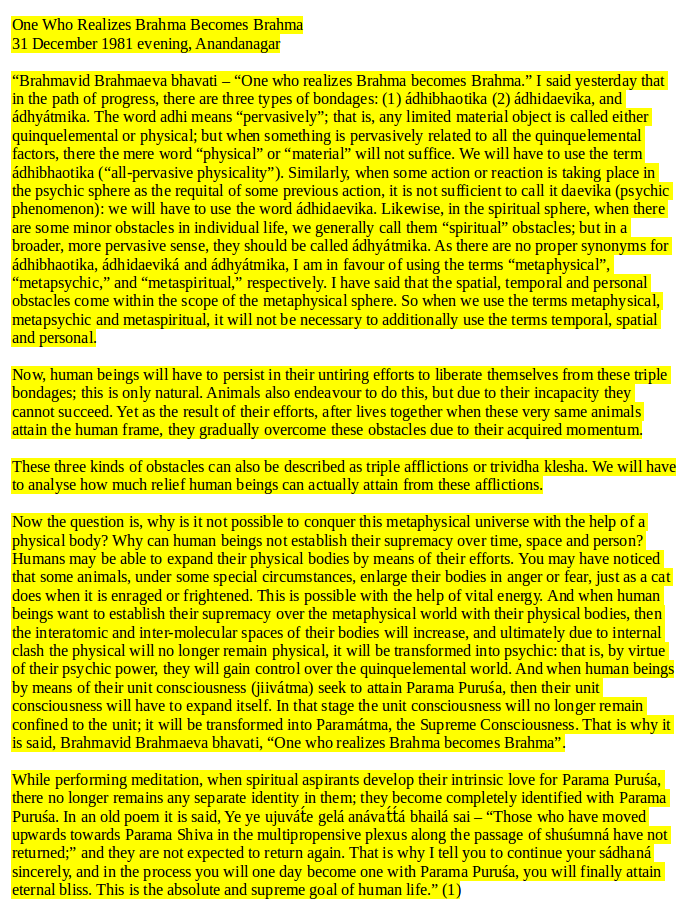
Here below in yellow is the entire discourse as published by our Tiljala Publishers. In the below discourse, you will not find anywhere the above green sentences which Bábá spoke during the Hindi segment of this very discourse.

Please review the below yellow for yourself; you will not find there the above green sentences (or even sentences expressing their meaning):


So the above yellow is the TP-published discourse, "One Who Realizes Brahma Becomes Brahma". In this entire printed discourse, the above green sentences spoken by Bábá during the discourse are not to be found. And the reason is that although the discourse was given by Bábá in three languages-- Bangla, Hindi, and English, but our Tiljala Publishers have only printed the Bangla sections and discarded the English as well as Hindi sections.

This is our dharmic duty to protect our Guru's discourses. Please come forward to resolve this issue. What Guru spoke, is not reaching to you. Special interest groups are interposing themselves between you and your Guru. How long are you going to tolerate this ruination of your Guru’s teachings?

Namaskar,
Prakash


So many discourses Bábá has given in three languages. And many times Bábá said something in one language, but then the same things he did not speak in the next language. Rather He spoke new additional things. So in that case, until you combine what Bábá said in all those three languages during a given discourse, that discourse will not be complete. And ultimately due to Bengalization, our Tiljala Publishers (TP) have largely discarded what Bábá said in the other two languages English and Hindi. Only whatever Bábá spoke in the Bangla section of a given discourse, is included to become the published discourse. But actually that is only one third of the discourse.


Cops retrieve decomposed child

It is like a thief who stole a box off a train. In the process of escaping with the box he got caught by the police. Upon their questioning he insisted it was his own box. The police proceeded to open the box and found inside the dead body of a murdered child. So now the thief has trapped himself in a murder. The police had asked him if the box was his and he swore it was. Now he is trapped.

একটা চোর ৰাক্স চুরি করল চলা ত্রেন থেকে | পলাযনের সময পুলিসে ধোরা পড়ল | তাদের প্রশ্নের উত্তরে ৰোলল এই ৰাক্স তো আমার | পুলিশ ৰাক্সটা খুলে দেখল একটি খুন করা ছোট শিশুর লাশ ভিতোরে আছে | পুলিস ওকে জিজ্ঞাস করেছিল এই ৰাক্সটা কি তোমারে ? আরে ও ৰোলেছিল হ্যাঁ | এখন ও ফাঁদে পড়ল |

This is the situation of H group. With eyes closed, they are printing all the books of B group. When they will wake up, no one knows. But one thing is true, that these people are taking upon themselves full responsibility for the mistakes of the B group Publishers by putting their own name on the same publications. In a way they are involving themselves in the same sin. Otherwise, why haven’t they or why don’t they transcribe the discourse from the original discourse and print it anew on their own?

Having claimed credit as the publisher, they are now getting caught red-handed as the creators of distortion-filled discourses.


Note: In order to make Bábá’s teachings distortion-free, please forward this posting to the respected Tiljala Publications Secretary, dada Mantreshwarananda ji <Mantreshwarananda@hotmail.com>, and to respected dada Acyutananda ji, <acyutananda1@gmail.com>. As well, please send this posting to <hariishananda@gmail.com> and <acaryarudrananda@gmail.com>.

Full Version

Bábá spoke, "द्वैतभाव नहीं रहता है | जीव जब परमपुरुष के बहुत नज़दीक पहुँच जाते हैं—वैष्णव दर्शन के अनुसार, राधा जब कृष्ण के नज़दीक पहुँच जाती हैं तो; "वे [राधा], और राधा नहीं रहती हैं; वे कृष्ण बन जाती हैं" | आख़िर तक दो नहीं रह सकते हैं | दो सत्ताएँ नहीं रहतीं हैं, एक सत्ता रहती है | जीव-भाव, परमपुरुष के नज़दीक आते-आते होता है क्या ? उनमें परिवर्त्तन आता है | और यह जो परिवर्त्तन, यह जो विवर्त्तन हो रहा है, इस विवर्त्तन के कारण होता है क्या ? वह जितना नज़दीक पहुँचेगा; उतना ही {वह} विवर्त्तन, {परमात्मक} परमात्मिक विवर्त्तन होगा | और जीव जब—एकान्त-निकट में पहुँच जाते हैं, तब last विवर्त्तन जीव में यह होता है कि—वह ख़ुद परमात्मा बन जाता है | "ब्रह्मविद् ब्रह्मैव भवति |"" (2)

References.
1. Printed by Tiljala Publishers, "One Who Realizes Brahma Becomes Brahma", Electronic Edition 2009 and A Few Problems Solved, part 5.
2. As-Is version, "One Who Realizes Brahma Becomes Brahma," MGD 31 December 1980 Ananda Nagar.

== Links ==

Recent postings


Mantreshwaranand, Mantreshvarananda, Mantreshvaranand, Mantreshvaránanda, Acyutananda, Acyutanand, Acyutánanda, Hariishanand, Hariishánanda, Rudrananda, Rudranand, Rudránanda