Friday, September 18, 2015

Here Is Baba's Voice: Check for Yourself


From: Krishna Ganguly <kganguly@bengalcom...>
To: Ananda Marga Discourses <anandamargadiscourses@sunlink.net>
Subject: Here is Baba's Voice: Check for Yourself - 1
Date: Fri, 18 Sep 2015 12:17:53 +0530

Bábá


Here is Baba's Voice:
Check for Yourself - 1


Note: For purposes of authenticity, the sound file of Baba's discourse has been provided so you can check for yourself the veracity of this entire episode. One should not be misled by those who would try to keep you from accessing the proof as to what Baba really said.

This is a follow-up letter on a topic posted on 25 July 2015. Some readers had questions and asked for more explanation – hence this writing.

Respected Márgii Brothers and Sisters,
Namaskar.

In the discourse “The Supreme Entity transcends All Colors”, Bábá has spoken mainly in English. (1) All the principal ideas Bábá presented in English, and He spent 68% of the time speaking in English. (2) Yet as we have seen, dada Sarvatmananda has printed in the TP [Tiljala Publishers] Publishers Note that Bábá has delivered the “Discourse in Bengali” only. (3)


Translated Bengali Edition Falsely Treated
As Original Discourse

There is a second extremely serious distortion committed by dada Sarvatmananda in the English edition. Not only have our Kolkata dadas falsely claimed the discourse as given by Bábá in Bengali; our Kolkata dadas have taken the liberty of translating the English discourse into Bengali, treating their self-written Bengali version as the original, and translating from their Bengali back into English for the English edition. That is the serious distortion committed by dada Sarvatmananda.

This is a shady technique we call Bengalization, and is used by those in-charges throughout this discourse. ​Bengalization has the nasty effect of changing all the words in the discourse. Whatever words Bábá used in the original English were all translated into Bengali. And by the time the Bengali is translated back into English, nothing remains of the original English words Bábá used. ​That is the serious distortion committed by dada Sarvatmananda.


Proof of Distortion

​So here is the proof, just make the comparison for yourself: we have placed dada Sarvatmananda's published English discourse on the blog for you to inspect. (4) And Bábá's original sound recording is also on the blog. (5) Compare what Bábá says to what our Kolkata dadas wrote. You will find that although both are in English, there is not a single line in what our Kolkata dadas printed which is just like what Bábá spoke. Every single idea is reworded and the reason for it is that it has ALL been translated twice—English to Bengali, and then Bengali back to English. That is the serious distortion committed by dada Sarvatmananda. And H group dada Rudrananda has also accepted Sarvatmanandji’s distortions, by printing them in H group’s own books.


Retranslated Bangla into English
Instead of Using Bábá's Original English Words

During main sections of the discourse Bábá spoke only in English. Those were translated into Bengali for the initial publication of the discourse in Bengali in Ánanda Vacanámrtam part 10 in 1980. Then for the first publication of the discourse in English in 2007, the Tiljala Publishers translated all those sections back from Bengali into English—instead of using the original English Bábá spoke on the recording.


Tremendous Loss Due To Bengalization

Bábá says that 25% of a discourse is lost in translation. And dada Sarvatmananda took a discourse which Bábá has given mainly in English, and translated it into Bengali and then from his Bengali version back into English. Translating twice in this way, dada Sarvatmananda has caused the loss of well over 50% of the meaning—all because of their desire for Bengalization. Indeed by translating the material twice, veritably 50% of what Bábá has said is gone. Translating once yields 25% loss, and translating twice yields 50% loss.


Re-Translation Policy Exposed

The filthy, blind policy which dada Sarvatmananda has adopted of translating Bábá's discourses into Bengali and falsely showing his own translated Bengali to be the original discourse—this policy has been exposed in this discourse clearly for all to witness. Listen to the sound file on the blog (5), and you'll know Bábá has given the discourse in English. What was the need for dada Sarvatmananda to translate Bábá's original English words into Bengali and then again from Bengali into English? What our Kolkata dadas have published in English is their twice-translated version (English → Bengali → English), and not Bábá's original words.


Open Your Eyes –
Thieves Stealing Your Guru's Teaching

O brothers and sisters! How long will you continue in the dark? Open your eyes—thieves are stealing before your very eyes. Guru's entire shástra is being ruined by these great purodhas. —Open your eyes and see the truth.

Guru Shrii Shrii Anandamurtiji has given His guideline for you, but it will not reach you.​ How long will you remain quiet – speak out.​

At His Feet,
Krishna Ganguly


Footnotes.
1. The Supreme Entity Transcends All Colours , Ánanda Vacanámrtam Part 9-10, Chapter 18, p. 113.
2. In this discourse, Baba spoke 68% in English and only 32% in Bengali. Indeed in the whole discourse there is only one para Bábá spoke only in Bengali.
3. Here is a scan of the the Publishers Note page in Ánanda Vacanámrtam where the Tiljala Publishers labeled the English discourse “The Supreme Entity Transcends all Colours” as having been delivered by Bábá only in Bengali.
4. Here are scans of Tiljala group's published English discourse - “The Supreme Entity Transcends all Colours” - for you to inspect.
5. Click here to download the sound file of the discourse, “The Supreme Entity Transcends all Colours”. Then you can compare it with the scans of Tiljala group's published English discourse.

Be sure to download this file and save it for your sons and daughters, grandsons and granddaughters. Otherwise they will only receive the message from Tiljala group that the discourse was translated from the original Bengali, and gradually the dogma will be spread that Bábá knew only Bengali.


If you have any difficulty downloading the file, write and let us know at Ananda Marga Discourses <anandamargadiscourses@sunlink.net>. We will help you.

6. Baba's sound file can also be directly listened to on-line in the following way: When you open our blog page, you will see on the right side at the top a “box” which says “The Supreme Entity Transcends all Colors”. Click on the mp3 icon in the box to listen to the sound file.

Also, there on the right side of the box there is a button to click for options. One of the options is “download”. 

Sunday, August 23, 2015

Proof: Rudranandji Follows Sarvatmanandji

From: Vijay Dev <vijaydev@rangenet.......>
To: Ananda Marga Discourses <anandamargadiscourses@sunlink.net>
Subject: Proof: Rudranandji Follows Sarvatmanandji
Date: Sun, 23 Aug 2015 11:27:58 +0530


BABA


Proof: Rudranandji Follows Sarvatmanandji


Namaskar,


Everyone is well aware that Rudranandji and Sarvatmanandji can not see eye to eye. And they are dead enemies. Indeed everyone knows that Rudranandji put Sarvatmanandji in jail also, in the murder case. But one strange thing is there that, on one issue Rudranandji follows in the footsteps of Sarvatmanandji. And we are going to discuss that very topic. It is just like the main thug of one gang is the dead enemy of another gang. But they may come together to loot some village, as a joint venture-- if their common interest is served. In that case they can join together and go for looting. So here the issue is that both Rudranandji and Sarvatmanandji want to destroy Baba's teachings. On that point, they are bosom buddies. Here is the example. First see below what is Sarvatmanandji's standard protocol. And then following that, how Rudranandji followed suit in executing it. The proof of this episode is provided at the end of this letter.


Sarvatmanandji's Dogmatic Protocol


Tiljala Publications' normal, standard, dogmatic protocol is that any discourse Baba gives should go via Bangla and only then into any other language (such as English) for publication. So in order to carry out the protocol, the DMC discourse "Mysticism and Spirituality" (given by Baba in Hindi), was translated from Hindi into Bangla, and then from Bangla into English where it was printed in SS24. And then, in order to print SS24 (Hindi), it was again translated from English back into Hindi.


But according to Baba, when He has spoken in Hindi then His own original Hindi words should be directly printed for the Hindi publication. The Hindi for printing must not be made via Bangla, when Baba has Himself spoken originally in Hindi.


By simple analogy, one can understand. Suppose you have a white T-shirt, and you want to use that. Then suppose if there is a dogmatic belief that this shirt should go via a bucket of black charcoal. And by so doing the shirt became filthy black. The original white color became permanently lost. So "via Bangla" is like that. When Baba's original Hindi is filtered through a Bangla translation to make the printed Hindi, then in that process Baba's original Hindi words get completely lost. And that is what happened with this discourse. The proof of this episode is provided at the end of this letter.


How Rudranandji Follows in Footsteps of Sarvatmanandji


Baba has given this discourse "Mysticism and Spirituality" in Meerut, and it is obvious and well known that He spoke in Hindi. So, Sarvatmanandji got it translated from Hindi into Bangla, and then from Bangla into English , and He published it in SS24, in English. After that, he got it translated from English into Hindi. And using that translation, Sarvatmanandji made the Hindi SS24 book. The proof of this episode is provided at the end of this letter.


Rudranandji, Sarvatmanandji, Joint Venture


And now recently, Rudrananandji gave the order to his stooges to quickly follow suit. So the stooges started copying Sarvatmanandji's garbage and printing those things in their Prajina Bharatii magazine, page after page after page. In spite of protest by various Margiis that those Hindi Meerut discourses were given in Hindi, and should be transcribed directly and printed in the SS series. But the Margiis' cries fell on deaf ears. So for your proof, to see the fact of the matter, please scroll down to check the scan of the falsified Baba's discourse, by Rudranandji, Sarvatmanandji, and company in their joint venture.


And also confirm for yourself with the sound file of Baba's original discourse of that DMC. Then it will be crystal clear to you that what Baba spoke, does not match at all with what is printed there. And so you will understand the seriousness, of how Rudranandji follows in the footsteps of Sarvatmanandji, and is busy in ruining and destroying your Guru's discourses. How long will you ignore this? You have to pay your debt to Guru by protecting His discourses, at the cost of your life. That is what true disciples do.


Baba’s Analogy of Destructive Activities of Mice & Termites---Sarvatmanandji &  Rudranandji


See here, what Lord Shrii Shrii Anandamurtiji has taught that His discourses should be protected from bad elements. In this following teaching, Baba equated them with mice and termites. Baba says, "You people know that when clothes are woven white ants and mice try to eat them. So the cloth has to be saved from the destructive activities of white ants and mice. So whenever you make something, establish a protective fence to protect it from the evil forces." (1)


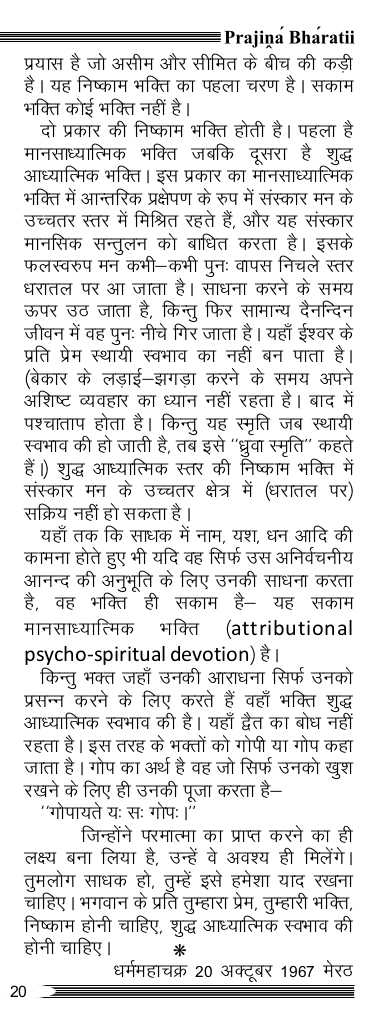
Here we are giving you one page of the discourse, "Mysticism and Spirituality", as an example. The rest of the pages will be provided to anyone who requests with us. This discourse is printed in Prajina Bharati #250, pp.16-20. Below is the scan of the final page, page 20. This final section of the discourse as printed in Prajina Bharati, contains 314 words. In contrast, the equivalent recently transcribed final section in the As-Is discourse, which follows below, contains 888 words. This comparison of 314 and 888 words is of the very same final section of the discourse. Baba spoke 888 words, and Prajina Bharati printed 314 words. PB is using the original language spoken by Baba here, so it should be exactly the same. Yet what Baba spoke is almost three times as long as what PB printed. To be precise, Baba’s actual As-Is discourse segment is 2.8 times the size of PB’s version. By the word count alone one can understand that they ruined what Baba has given, that what Prajina Bharati printed is completely different from what Baba spoke in Meerut.


So here below is the Prajina Bharati printing of "Mysticism and Spirituality" discourse, from SS-19 Hindi.


Mysticism_Adhya_39_tma_p.jpg


Mysticism_Adhya_39_tma_p(1).jpg


The above scan is the final segment of the discourse "Mysticism and Spirituality" as printed in Prajina Bharati - originally from Subhasita Samgraha - 19 (Hindi). The section presented in the above scan contains 314 words. The below scan is the "As-is" version of that same section of the same discourse, "Mysticism and Spirituality." This below As-Is transcription contains 888 words. 


As Is - Final Section p.1 [smaller font].png


As Is - Final Section p.2 [smaller font].png


After looking at the above two versions of the concluding portion of the discourse"Mysticism and Spirituality", anyone can see that the second version, i.e the As-is version with 888 words, is nearly three times as long as the first version from Prajina Bharati that contains only 314 words.

Namaskar,


In His Service,
Vijay


Footnotes.
1. Due to some technical reasons, the audio of this DMC discourse cannot be placed on the blog. Those who are interested to have Bábá’s Bangla audio file, should please contact us.


2. Sarvatmanandji personally gave the duty of ruining these discourses to his three stooges. They are the ones who involved in translating Baba’s original Hindi into English and then translating back into Hindi for publication-- thus abandoning Baba’s original Hindi:


Stooge #1 = Gaurishankar from Ara
Stooge #2 = Pradyuman ji from Purnia
Stooge #3 = Devaria


Then Rudranandji & the PB team list below followed Sarvatmanandji, by copying the discourse he made and pasting it into Prajina Bharati.


Here below are the stooges of Rudranandji, who produced the Prajina Bharati magazine:


Acarya Rakeshananda Avt
Acarya Amaleshananda Avt
Acarya Pus’pendrananda Avt
Acarya Pran’aveshananda Avt


Pradyumna ji, of Purnia Bihar, and Gauri shankar of Ara, Bihar


3. Specifically Pradyumna ji, of Purnia Bihar, and Gauri shankar of Ara Bihar are the two stooges of Sarvatmanandji to ruin SS18 and SS19. Please call them as they were involved in the production of the above discourse for Sarvatmanandji. Ask why did they have it ruined. They do not have email access, so you will need to phone them. Their phone numbers are provided here below:


Pradyumna ji, of Purnia Bihar (91) 9661605762
Gaurishankar of Ara Bihar (91) 9431052800


References.

1. "Gurukul: History and Planning", Neohumanist Education.

Saturday, July 25, 2015

Tiljala Group Labels English Discourse As Bangla


The Tiljala Publishers Have Wrongly labelled an English discourse as having been given in Bengali. In this discourse, “The Supreme Entity Transcends All Colors,” Bábá has spoken mostly in English. Yet here in the Publishers Note to Ánanda Vacanámrtam Part 10, the Tiljala Publishers have clearly labelled the discourse as given in Bengali, and as Translated from the Original Bengali into English.

Click on the below scan and it will enlarge and become quite readable. On the right hand page you'll see one entry highlighted in red. That is the discourse, “The Supreme Entity Transcends All Colors,” which has been wrongly labelled by Tiljala Group. 


For more on this subject, read the posting located here.

English Discourse Labeled as Bangla—Bábá's Audio File Is The Proof

From: Gopal Ganguli <gganguli@tcom...>
To: Ananda Marga Discourses <anandamargadiscourses@sunlink.net>
Subject: English Discourse Labeled as Bangla—Bábá's Audio File Is The Proof
Date: Sat, 25 Jul 2015 10:42:27 +0530

BABA


English Discourse Labeled as Bangla


Bábá's Audio File Is The Proof

Respected Márgii Brothers and Sisters,
Namaskar.

Bábá has given the discourse “The Supreme Entity Transcends all Colours” on 11 April 1979 in Kolkata. About this discourse, Tiljala group wrote in the Publishers Note of Ánanda Vacanámrtam part 10—

The Supreme Entity Transcends all Colours”. Discourse in Bengali. Originally published in Bengali as “Varńa O Varńátiita” in Ánanda Vacanámrtam 10, 1980. Tr. from the original Bengali by Prof. Áditya Mohanty. (1)

So here in the Publishers Note, specifically about this individual discourse, Tiljala group has put in writing that the discourse was given by Bábá in Bengali. In fact, the statement that Bábá has given this discourse in Bengali is an out and out lie. And the following statement that the English discourse was translated from the original Bengali is equally misleading and patently false. The original discourse is in English, according to standard calculation. (2)


English Discourse Labeled As Bangla— Narrow Sentiment

The main language of the discourse is English. This is what Tiljala group should have written in the Publishers Note—that the discourse was given by Bábá in English. But instead they labeled the discourse as having been given in Bengali.


This Sound File Included as Proof Of Deception

Included with this posting is a link to the sound file of the discourse. (3) Bábá delivered this discourse mainly in English, and the sound file can be listened to by all as proof.


They Just Thought No One Would Check


With Bábá's Audio File

Here there can be no excuses or justifications. This claim “Discourse in Bengali” was made by Tiljala group in the Publishers Note, specifically about this discourse “The Supreme Entity Transcends all Colours”. It is obvious that they think no one will check their work, and they can go on distorting the facts and befooling Márgiis that Bábá spoke in Bengali, when it is not at all the main language of the discourse.


English Discourse Presented As Bangla—Unfortunate

This is a clear example of misuse of the scripture to misguide the people. If Bábá spoke principally in English, then it should be reported in the Publishers Note that Bábá spoke in English. Reporting that discourses have been given “In Bengali” when it is not the case, can be done only with intent to befool and misguide. Otherwise what is the need?


Desire To Prove The Superiority of Bengali

The attempt to misreport English discourses as being “given in Bengali” is the result of nasty language sentiment and the desire to prove the superiority of Bengali, that it is a holy language. Otherwise in the absence of such sentiment, the discourses would have been reported in the language in which they were really given. In this case, English.

Regarding the case shown here from the Tiljala Group Publishers Note—

The Supreme Entity Transcends all Colours”. Discourse in Bengali.

It should be further noted that this is a common example and not at all an exception. This scenario—Tiljala Group claiming a discourse to have been given in Bengali when it was not—is all too common. There are many, many examples of the same, and they will be sequentially presented on this Network.


Bábá Warns: Deceitful Intellectuals Are


The Most Dangerous

Here below Bábá tells in Hindi using very strong language that on the spiritual path, sincerity is the most important quality. And that sincerity means being a speaker of the truth. Bábá points out that deceitful intellectuals do not follow the path of sincerity, and choose instead to befool the public so as to take advantage of them.

Our Tiljala Publishers have been pointed out as claiming “Translated from the Original Bengali” when the original language is not Bengali. But rather than accept the fact and express repentance for what wrong they have done, they instead continue their insincerity by printing Publishers Notes like the one shown above, with the obvious intention to befool Márgiis.

About such types of persons, those who abuse their intellectual faculties to befool others, Bábá says—

तो, यह जो intellectuals, यही आम जनता को विभ्रान्त किए हैं | और हम बोले, क्या ? Sincerity first, sincerity second, sincerity always | साधनामार्ग में sincerity सबसे बड़ी चीज़ है | और, sincerity क्या है ? Sincerity is always सत्याश्रयी | Sincerity माने ही सत्य में रहना, मज़बूत रहना | [EGD 25 November 1978 Bombay, “Taking Shelter in Satya is the Essence of Sádhaná”]

Bábá continues on in the next para of the same discourse to explain that if such deceptive intellectuals are one's own close persons, or are present in one's own house, then that is most dangerous. It is like there being a snake, but in one's house instead of outside in the yard—

अपना आदमी हो, घर का आदमी हो | कोई सत्य से इधर-उधर हट गया, sincerity की कमी जिनमें है—उसका विरोध करो,बर्दाश्त मत करो | अपना आदमी है तो क्या है | अपना आदमी अगर असाधु है, insincere है, तो, और भी अधिक ख़तरनाक है | क्यों ? बाहर में अगर साँप रहा, वह जितना ख़तरनाक है, घर में अगर साँप घुस गया तो और भी अधिक ख़तरनाक है | इसलिए, और भी, उसका अधिक विरोध होना चाहिए |” [EGD 25 November 1978 Bombay, “Taking Shelter in Satya is the Essence of Sádhaná”]

Here is the translation of this second para—

If our own person or relative deviates from the truth or is lacking sincerity, oppose him, do not tolerate him. It does not matter if he is our own relative. If our own person is dishonest and insincere then he is more dangerous. Why? If there is a snake outside the house it is dangerous, but if it enters inside the house, it becomes more dangerous. Therefore he [our close person] should be opposed more strongly.” (Taking Shelter in Satya is the Essence of Sadhana, EGD 25 November 1978 Mumbai)


Those Who Distort Discourses Are Hypocrites

The Tiljala Publishers have written that they have not lied in their use of the phrase “From The Original Bengali”, and yet there is direct proof of their falsehood with this very discourse—

The Supreme Entity Transcends all Colours”. Discourse in Bengali.

And there are many more discourses with which they have done the same.

Bábá says the word to use in describing persons who say one thing and do another is “hypocrite”. Here Bábá explains that the Saḿskrta word for this is kápat́ika—

Kapat́a + t́hak (according to another view, t́haiṋ) = kápat́ika. In its common usage, kápat́ika means: l) a t́hag (one who cheats people), 2) a counterfeiter (one who is engaged in counterfeiting currency notes, medicines, etc.), 3) an obstinate person, 4) one whose appearance is different from reality (a hypocrite). In Sanskrit the word páśańd́a is used for “hypocrite”. 5) An immoral or dishonest person, 6) a person of evil nature, 7) a habitual flatterer. [Shabda Cayaniká Part 4]

Bábá explains that the Hindi word for hypocrite is pákhańd́ii—

In Hindi a hypocrite is called pákhańd́ii. Hypocrisy can take many forms, but we are mainly acquainted with the following three: (1) getting one's purpose served by exploiting or cheating others; (2) unnecessarily dominating somebody to conceal one's own ignorance or weakness; (3) pretending to be moral by criticizing the sins of others, which one secretly commits oneself. [Disc Tantra Vol I]


Such Hypocrites Are Not To Be Tolerated In Society

In all these languages, the word hypocrite has a similar sense—one whose actions and words are at variance with one another. And Bábá further explains that one should not tolerate the actions of hypocrites.

Bábá says, “Sincerity is reflected in actions, not in words only. One who displays sincerity in words but not in actions is a hypocrite. You should not tolerate hypocrites, not at all.” [AV23]

The Tiljala Publishers say they do not wrongly use the phrase “From the Original Bengali”, and yet in this discourse we see direct proof that they claim the discourse was given in Bengali, when it was not.

The Supreme Entity Transcends all Colours”. Discourse in Bengali.

And even after being confronted with the facts, they ignore it or deny it altogether. This sort of behavior Bábá warns is the most inimical because it is committed by one's own close persons with intent to deceive. It is most dangerous, and must not be tolerated. In this regard Bábá explains that to overlook or ignore such misbehavior would be very bad and would lead to still worse societal damage—

You may come to a temporary truce with a hypocrite, but do not forgive till his/her nature is reformed. Immediate forgiveness is a special weakness of mind. It results in worse harm to society.” [Caryácarya Part 2]


Those Who Call For Universalism Yet Work For Bengalism


Are Hypocrites

Most importantly, Bábá specifically says those who call out slogans of universalism all the while working for groupist interests, are hypocrites. And Tiljala Group is doing just this, giving the clarion call of Neohumanism all the while working to propagate Bengalization.

About this Bábá says,

Those who cherish class distinctions, communalism, provincialism and casteism while indulging in propaganda about universalism are also hypocrites.” [Caryácarya Part 2]


There Should Not Be Any Loophole in AM Books

Bábá warns, “If one is not able to give the people proper guidance, then at least one should not misguide them. … There must be an excellent and all-embracing philosophy, in which there should be no loophole in any sphere of mind as far as possible.” (NSS, Disc: 14)

I complete this posting with this following Bábá's Ánanda Váńii:

The accumulated distortions of many lifetimes cannot be removed in the twinkling of an eye. The removal of these distortions requires prolonged cultivation of knowledge, selfless devotion and untiring action.”

The world expects tremendous work from you; so you must not sit idle like a frog in a well under the spell of inertia. Therefore awake, arise.” [Ánanda Váńii #5]

Namaskar,

Gopal Ganguli

Footnotes.

1. Click here to view a scan of the Publishers Note page in Ánanda Vacanámrtam where the Tiljala Publishers labeled the English discourse “The Supreme Entity Transcends all Colours” as having been delivered by Bábá only in Bengali.

2.
Bábá Spoke Mainly In English

Here is the breakdown of the amount of time Bábá spent in this discourse speaking English and Bengali. The total discourse length is 10:47 minutes; of that, Bábá spoke in English for 7:15 minutes, and in Bengali for 3:32 minutes. That means Bábá spoke in English 68% of the time, and in Bengali merely 32% of the time. In such a case, how could Tiljala group write in their Publishers Note that the discourse was given only in Bengali? This statement is a flat-out lie. And they have no excuse to justify this lie: they have the sound recording, and after listening to it and knowing the contents of this mainly English discourse, they have reported—“Discourse in Bengali”.

In brief, here is the breakdown of time Bábá spent speaking each language:

English = 7:15 min total = 68% of discourse

Bengali = 3:32 min total = 32% of discourse

                 10:47 total time

3. Click here to download the sound file of the discourse, “The Supreme Entity Transcends all Colours”.

Be sure to download this file and save it for your sons and daughters, grandsons and granddaughters. Otherwise they will only receive the message from Tiljala group that the discourse was translated from the original Bengali, and gradually the dogma will be spread that Bábá knew only Bengali.


If you have any difficulty downloading the file, write and let us know at Ananda Marga Discourses <anandamargadiscourses@sunlink.net>. We will help you.

4. Baba's sound file can also be directly listened to on-line in the following way: When you open our blog page, you will see on the right side at the top a “box” which says “The Supreme Entity Transcends all Colors”. Click on the mp3 icon in the box to listen to the sound file.

Also, there on the right side of the box there is a button to click for options. One of the options is “download”.


5. Discourse Mostly in English: Tiljala Still Reports “Given in Bengali”

The main ideas in this discourse Bábá has given in English, and not in Bengali. Bábá spoke very little in Bengali in this discourse. Despite this, the Tiljala Publishers claimed in writing in the Publishers Note that this discourse was given by Bábá only in Bengali.

Sunday, July 12, 2015

Litter in SS-11

From: Chetan Roy <cr88945@gdocs.......>
To: Ananda Marga Discourses <anandamargadiscourses@sunlink.net>
Subject: Litter in SS-11
Date: Sun, 12 Jul 2015 12:09:37 +0530


Bábá


Litter in SS-11


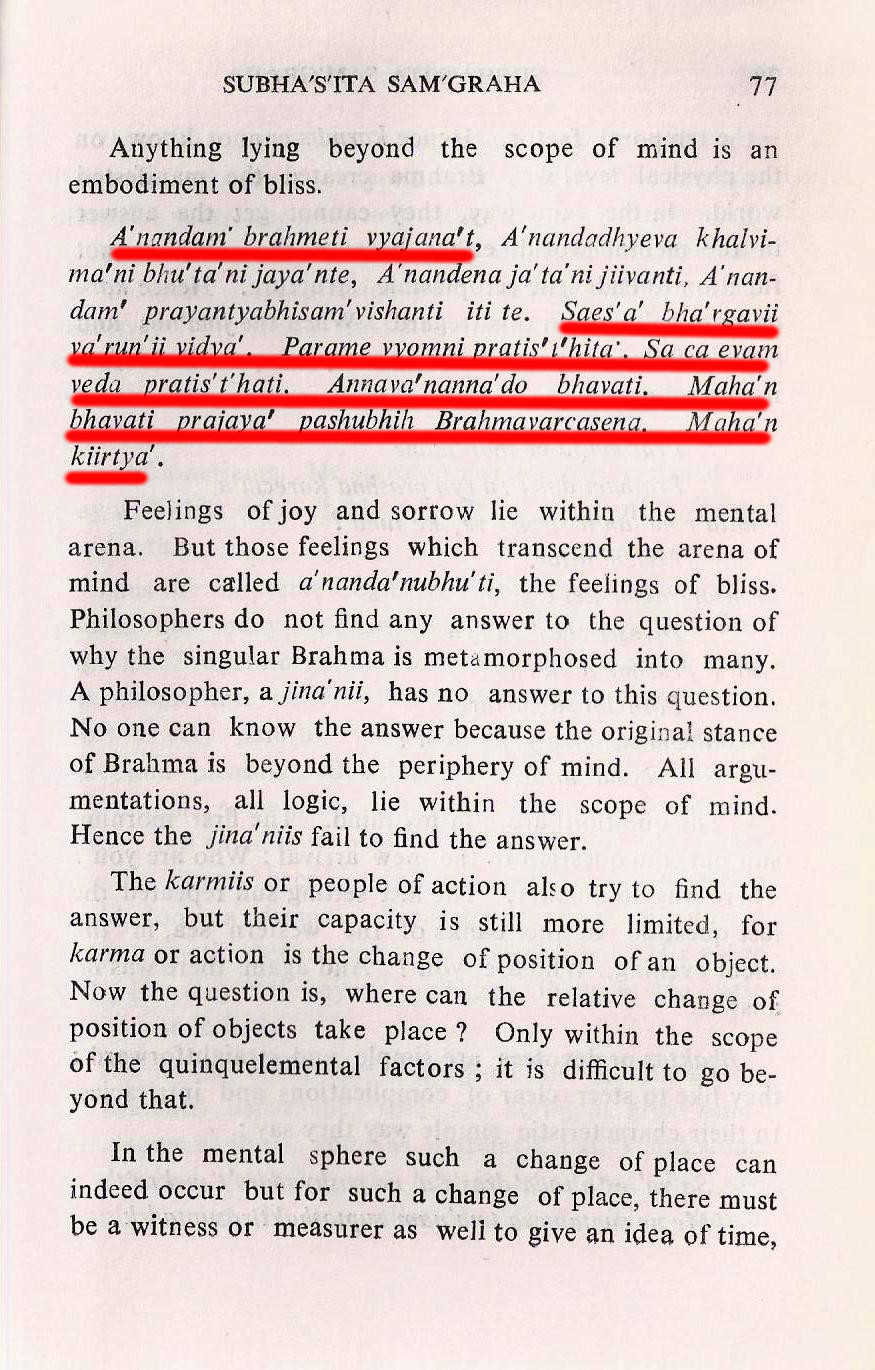
The Guru’s discourses are ápta vákya. It is the duty of Publications Department to properly transcribe and print Bábá’s original discourses in a methodical way, and pass that on to the readers. But look what has happened-- they did just the opposite. They added litter in the following DMC discourse. The things which Bábá did not tell, they added from their own side. When books are printed, Márgiis rush to purchase them and with great reverence they memorize every word of shlokas. All those Subhásita Samgraha shlokas are memorized by new WT trainees as well. It is in their curriculum. So by adulterating this section, Publications Department ruined the entire thing. The sanctity is lost. And it has a cascading effect. People will read this garbage as if it is Guru’s teaching. But that is far from the truth. And unnecessarily trainees are memorizing these things.


Underlined Sections Are All Garbage
This whole scandal is disgraceful. For your own confirmation, just see the scan of the discourse placed here below. The underlined sections are all garbage. Bábá did not speak those lines. Bábá has given this discourse in Siliguri, in the Bengali language. So we are also going to give the sound file. Please see the footnote.


Write Tiljala Publishers to Throw Away Unsold Books

Please forward this letter to Márgiis and WT’s so everybody can correct their book, and request the Tiljala Publishers to throw away unsold books and reprint another one. Without the active cooperation of all disciples of Shrii Shrii Anandamurti, these objects of litter will not be cleaned out from our holy scriptures.


Supramundane Heritage (with red underline).jpg

Namaskar,
Chetan Roy


Footnotes

1. Due to some technical reasons, the audio of this DMC discourse cannot be placed on the blog. Those who are interested to have Bábá’s Bangla audio file, should please contact us.

Sunday, July 5, 2015

Distortion: Bhukti Pradhána -- Food-Engorging Chief?

From: Bhakti <bhakti@ren....>
To: Ánanda Márga Discourses <anandamargadiscourses@sunlink.net>
Subject: Distortion: Bhukti Pradhána -- Food-Engorging Chief?
Date: Sun, 5 Jul 2015 11:26:57 +0530

BÁBÁ

Distortion: Bhukti Pradhána -- Food-Engorging Chief?


Namaskar,


Tiljala Publications (TP) has ruined Bábá's teachings. It is laughable. Here is one prominent example-- just take the term "bhúkti". If bhukti is written without an úṋcii on the “u”, like bhukti, it means “enjoying and gorging on food”. And with an úṋcii, i.e. bhúkti, then it means “area, territory, district”. And Pradhána means "chief". Unfortunately TP has ruined the sense of Bhúkti Pradhána (BP) in Bábá’s discourses, by writing it without an úṋcii on the “u”, like bhukti. And what to speak of the many discourses where BP has been mentioned, but in the very BP chapter where BP is the main subject-- there also it has been written without úṋcii, like bhukti and this ruins the meaning.   


Who is The Main Person Responsible for Distortion of AM Books


Everybody knows that although Sarvatmanandji is in Purulia jail these days on a murder case, but he is the father of the distortion scandal in Ánanda Márga Scripture since the very beginning. So this particular letter is just the tip of one iceberg. The bottom line is, the credit of ruining Ánanda Márga Shástra, goes to Sarvatmanandji.


With or Without Úṋcii

Our Ánanda Márga books are available in the open market. When non-Márgiis read about a “Bhukti Pradhána” without an úṋcii on the “u”, like Bhukti, in our AM books, then they think that in AM there is a food-engorging chief. This all came to my attention, when one non-Márgii raised the point to me, "Who is your gorging chief?" I could not understand. Then he explained more. And that became the cause of this letter.

Bábá’s Guideline - Correct Spelling of Bhúkti

First let us see what the correct way of writing Bhúkti is. In His description of the term Bhúkti provided during a field walk in Pune, in the year 1979, Bábá very clearly provides the etymology. See the following excerpt (and yellow highlighted portion for the etymology) from the As-Is transcription of the audio recording of the discourse.


Excerpt of Bábá’s Audio File Transcription


Fieldwalk Pune - 2
26 November 1979 Pune

[बाबा बोले--] हरित से हरा | हरित धान्य the land of green vegetable, vegetation | हरित धान्य माने "vegetation, not paddy" | Paddy का संस्कृत व्रीहि | तो, land of green vegetation | चारों तरफ़ हरा भरा देख रहे हैं | Central Asia के आदमी आए | Dry area के...वाह हरा है | तो, हरित धान्य → हरिया हन्य → हरि हाना → हरियाना | 

[मार्गी---"हरियाना |"]

[हँसी]

[बाबा बोले--] भूक्ति-प्रधान---तो भूक्ति spelling भ में बड़ी ऊ, दीर्घ ऊ | हाँ | "भूञ्च्‌" धातु क्तिन्‌, प्र minus धा plus अन‍ट्‌ = भूक्ति प्रधान |

[Editor---बाबा पैदल घूम रहे हैं, जिसकी ध्वनि सुनाई दे रही है |] 

[बाबा बोले--] रामानन्द !

[PA---"हाँ, बाबा !"]

[Excerpt of Bábá’s Audio File Transcription Ends Here]


Explanation in English
of Bábá’s Teaching on the Spelling of “Bhúkti”

For those who cannot read Devanágari script, the translation of Bábá’s explanation of the spelling of the word bhúkti is as follows:
Bábá says: “In the spelling of bhúkti, following “bh” is a big “ú”, long “ú”.

As per Bábá’s explanation:
Wrong spelling of the term bhukti = bhukti
Right spelling of the term bhúkti = bhkti

Meaning of bhukti if it is spelled wrong = “enjoying and gorging on food”
Meaning of bhukti if it is spelled right = “area, territory, district”

Bábá goes on to explain the technical etymology of this word bhúkti, as further proof of why there needs to be placed an úṋcii on the “u” so as to make it long. Bábá says:

“Bhúiṋc” dhátu ktin, pr minus dhá plus anat = Bhúkti Pradhána

Bábá is explaining that the root verb itself from which the word bhúkti is made, has a long “ú” in it. And so the word bhúkti -- in order to carry the sense “area, territory, district” -- must also have a long “ú”.

The essence of Bábá’s explanation is “In the spelling of bhúkti, following “bh” is a big “ú”, long “ú”.


Grave Mistakes by TP in the Spelling of “Bhúkti – A Few Examples
TP in numerous highly critical places mistakenly used bhukti instead of bhúkti (note the use of the úṋcii on u). This is all the more problematic because the mistake has been committed on central shástras of Ánanda Márga. Let us consider a few examples.

Example # 1- Mistake in Caryácarya Part 1

Bhukti means a particular administrative area akin to a district in India or a county in Britain. The Ánanda Márga Pracáraka Saḿgha (AMPS) secretary of such a bhukti will be known as a bhukti pradhána. [Pradhána means “head” or “principal person”.]


Election of Bhukti Pradhána


The sadvipras (those who are well-established in Sixteen Points(1)) of a bhukti must elect one bhukti pradhána from among themselves. The bhukti pradhána may or may not be an ácárya/á or a táttvika, but must be an educated family person. They will hold this post for three years, after which a fresh election will be held.


The Bhukti Committee


The Bhukti General Committee will be constituted of representatives elected by the sadvipras from among themselves. It will consist of a maximum of twenty-five and a minimum of fifteen members. With the consent of 80 per cent of the members, the number of members may be raised above twenty-five.


The bhukti pradhána will be the chairperson of the Bhukti General Committee. He/she will also form a Bhukti Executive Committee consisting of his/her chosen members. The number of members of the Bhukti Executive Committee will be determined at the discretion of the bhukti pradhána. A maximum of three members of the Bhukti Executive Committee may be sadvipras who are not members of the Bhukti General Committee; the rest must be members of the Bhukti General Committee.

Example # 1- Mistake in Caryácarya Part 1 (Ends here)


In the above example, we can see how our central shástra has been corrupted by the callousness of TP. In the above passage, bhúkti has been misspelled (see the red highlighted word, which is printed by TP numerous times).


Due to Distortion - Great Teachings and Ideals Ruined

This kind of error makes a mockery of the great teachings and ideals of AM. Bábá has graciously provided us the system of Ánanda Márga, the path of bliss. For an ideal society, Bábá has provided a perfect system and all the microscopic details of the same. It is our supreme duty as Ánanda Márgiis, the fortunate disciples of Shri Shri Ánandamúrtii ji, to preserve these pearls for the present as well as the posterity. Distortions of the type where bhukti is used instead of bhúkti, make a mockery of Guru’s great teachings. What is intended to mean the chief of the territory/district comes to mean a food-engorging chief due to the error TP has committed and allowed to continue for the past fifty+ years and multiple editions.

Distortion: A Deep Rooted Problem - Not an Innocent Typographical Error

This may seem on the face of it as a simple innocent typographical error. However, if that is so then why does this error still remain in the most important published books of TP after numerous rounds of editing and reprints? Caryácarya is read by countless Ánanda Márgiis across the globe, many of whom have noted and pointed out these problems in editing. In spite of that the sixth edition and second reprint still has the spelling of bhúkti incorrect. Therefore, it can be concluded that the problem is not merely of typographical nature. The problem lies in the way TP machinery works and responds to important issues as these. The problem lies in the complacency of TP.


Conclusion

The wrong spelling of the term Bhukti Pradhána is Bhukti Pradhána.

The right spelling of the term Bhúkti Pradhána is Bhúkti Pradhána.


Namaskar,
Bhakti


Note 1: The posting ends here. But those who do not understand fully, for them more materials are given below.

Example # 1- Mistake in Caryácarya Part 1 (Continued)


Duties and Responsibilities of Bhukti Pradhána


In general, the bhukti pradhána is responsible for all items of the ISMUB Department - inspection, seminars, movements, utilization and boards - at the district level. They must also maintain all records of birth, játakarma, marriage, social functions, náráyańa sevá, divorce, death, shráddha and diikśádána.


In addition, the bhukti pradhána should settle petty civil and criminal disputes, authorizing both the prosecution and defence to engage their pleaders. (Any sadvipra well versed in Caryácarya may be a pleader for the purpose.)


They are to maintain the sanctity of all jágrtis, dhvajas [flags], pratiikas and pratikrtis [photos of Márga Guru] with the help of the jágrti secretary and others.


They must maintain the social solidarity of the bhukti by never allowing the individual interest of any person to go against the collective interest, and they may take disciplinary steps against a person (in consultation with their Bhukti Executive Committee) for deviating from the path of Sixteen Points.


They must help with cash, kind, labour and other physical and intellectual power in materializing the different public welfare plans and programmes of Ánanda Márga. The bhukti pradhána will maintain proper accounts of all income and expenditure of his/her bhukti.


The purodhá pramukha may increase or decrease the duties or responsibilities of the bhukti pradhána whenever so required with or without consultation of the Central Purodhá Board.


Example # 1- Mistake in Caryácarya Part 1 (Ends)


Example # 2

Samájamitram, Smártta, Jiivamitram and Dharmamitram

The bhukti pradhána of any particular sector within whose jurisdiction there is the largest number of A-class Ánanda Márga Pracáraka Saḿgha (AMPS) committees (see “Formation of Boards”), will be known as the samájamitram [friend of society] of that sector for that particular half-year (1st January to Vaeshákhii Púrńimá / Vaeshákhii Púrńimá to 1st January). They (samájamitrams) will be allowed to use the word samájamitram as a prefix to their names until another person of the same sector acquires this respectable rank. A bhukti pradhána retaining the status of samájamitram continuously for two years (four half-years) can permanently prefix the title to his/her name (but this will not be hereditary). A permanent samájamitram can no longer hold the post of bhukti pradhána.


If a bhukti pradhána is an ácárya/á, he/she will use the word smártta [“one who has proved one’s social worthiness”] and not samájamitram.


Of the nine samájamitrams, the one having the largest number of A-class committees in the world will be known as jiivamitram [friend of living beings]. A bhukti pradhána retaining the status of jiivamitram continuously for two years (four half-years) will permanently prefix the title to his/her name (but this will not be hereditary). A permanent jiivamitram can no longer hold the post of bhukti pradhána.


If a bhukti pradhána is a grhii [householder] ácárya/á, he or she will use the word dharmamitram and not jiivamitram.


If the samájamitram, smártta, jiivamitram and dharmamitram are males, it is advisable that they do not shave, although this is not compulsory.


The samájamitram and jiivamitram will deserve the same respect in the society as an ácárya/á. For this reason, even if it may seem necessary, no one will be entitled to take any social disciplinary action against them except a purodhá.

Example # 2- Mistake in Caryácarya Part 1 (Ends)


Note 2: In addition to the two examples provided above, TP has misspelled bhukti by leaving out the úṋcii, in nine other major discourses, thus giving it the incorrect meaning in those discourses as well, of “enjoying and gorging on food”.


References
(1)” Bhukti Pradhána”; Ánanda Márga Caryácarya Part 1.

(2) “Samájamitram, Smártta, Jiivamitram and Dharmamitram”; Ánanda Márga Caryácarya Part 1.